
Human BMPR-IB/ALK-6 PE-conjugated Antibody
R&D Systems, part of Bio-Techne | Catalog # FAB5051P

Conjugate
Catalog #
Key Product Details
Species Reactivity
Validated:
Human
Cited:
Human
Applications
Validated:
Flow Cytometry
Cited:
Flow Cytometry, Cell Selection, MACS
Label
Phycoerythrin (Excitation = 488 nm, Emission = 565-605 nm)
Antibody Source
Monoclonal Mouse IgG2B Clone # 477914
Product Specifications
Immunogen
Mouse myeloma cell line NS0-derived recombinant human BMPR‑IB/ALK‑6
Lys14-Arg126
Accession # O00238
Lys14-Arg126
Accession # O00238
Specificity
Detects human BMPR‑IB/ALK‑6 in direct ELISAs. In direct ELISAs, no cross-reactivity with recombinant mouse BMPR-IB is observed.
Clonality
Monoclonal
Host
Mouse
Isotype
IgG2B
Scientific Data Images for Human BMPR-IB/ALK-6 PE-conjugated Antibody
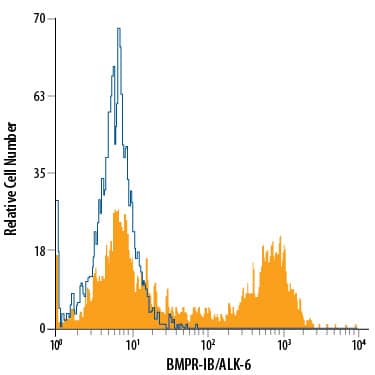
Detection of BMPR‑IB/ALK‑6 in PC‑3 Human Cell Line by Flow Cytometry.
PC-3 human prostate cancer cell line was stained with Mouse Anti-Human BMPR-IB/ALK-6 PE-conjugated Monoclonal Antibody (Catalog # FAB5051P, filled histogram) or isotype control antibody (Catalog # IC0041P, open histogram). View our protocol for Staining Membrane-associated Proteins.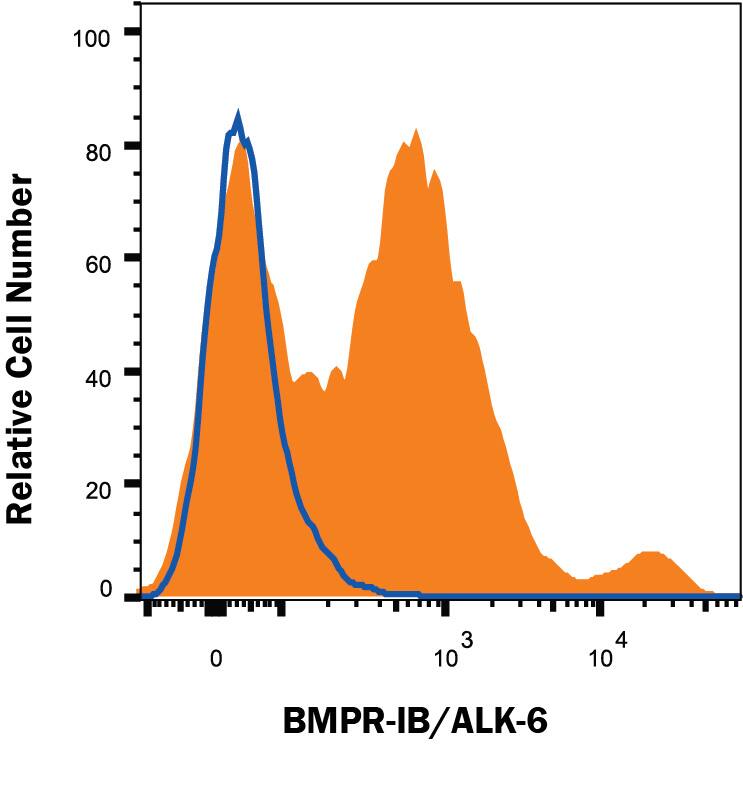
Detection of BMPR-IB/ALK-6 in Human iPS cells differentiated to Mesoderm by Flow Cytometry.
Human iPS cells differentiated to mesoderm (using Catalog # SC030B) were stained with Mouse Anti-Human BMPR-IB/ALK-6 PE-conjugated Monoclonal Antibody (Catalog # FAB5051P, filled histogram) or isotype control antibody (Catalog # IC0041P, open histogram). View our protocol for Staining Membrane-associated Proteins.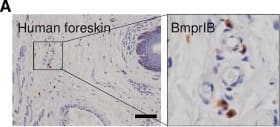
Detection of BMPR-IB/ALK-6 by Immunohistochemistry
Characterization of BmprIB+ dermal cells. (A): Immunohistochemical staining of BmprIB in human foreskin. (B): Percentage evaluation of BmprIB expression in freshly isolated human dermal cells by flow cytometry. Histograms of BmprIB expression (left; 3.5% ± 0.4%) and isotype control (right). (C): Cell morphology under phase‐contrast microscopy. (D): The proliferative potential was assessed with the Alamar Blue assay in usDCs and BmprIB+ cells. Cell numbers were quantified by the absorbance wavelength at 570 nm using a spectrophotometer at 24, 48, 72, and 96 hours. Data represented the mean of three individuals and each of them was the mean of triplicate experiments. The osteogenic potential of BmprIB+ cells was demonstrated by ALP staining (E) and ARS staining (F). (G): The mRNA expression levels of ALP (at day 7) and OCN, OPN, and BSP (at day 21) were analyzed by real‐time polymerase chain reaction after osteogenic induction. Data represent the mean ± SD (n = 3). ∗, p <.05 indicates statistical significance. Scale bars = 50 µm. Abbreviations: ALP, alkaline phosphatase; ARS, alizarin red S stain; BmprIB, bone morphogenetic protein receptor type IB; usDC, unsorted dermal cell. Image collected and cropped by CiteAb from the following open publication (https://pubmed.ncbi.nlm.nih.gov/28170187), licensed under a CC-BY license. Not internally tested by R&D Systems.Applications for Human BMPR-IB/ALK-6 PE-conjugated Antibody
Application
Recommended Usage
Flow Cytometry
10 µL/106 cells
Sample: PC‑3 human prostate cancer cell line and human iPS cells differentiated to mesoderm (using Catalog # SC030B)
Sample: PC‑3 human prostate cancer cell line and human iPS cells differentiated to mesoderm (using Catalog # SC030B)
Spectra Viewer
Plan Your Experiments
Use our spectra viewer to interactively plan your experiments, assessing multiplexing options. View the excitation and emission spectra for our fluorescent dye range and other commonly used dyes.
Spectra Viewer
Formulation, Preparation, and Storage
Purification
Protein A or G purified from hybridoma culture supernatant
Formulation
Supplied in a saline solution containing BSA and Sodium Azide.
Shipping
The product is shipped with polar packs. Upon receipt, store it immediately at the temperature recommended below.
Stability & Storage
Protect from light. Do not freeze.
- 12 months from date of receipt, 2 to 8 °C as supplied.
Background: BMPR-IB/ALK-6
Cellular responses to bone morphogenetic proteins (BMPs) have been shown to be mediated by the formation of hetero-oligomeric complexes of the type I and type II serine/threonine kinase receptors. BMP receptor IB (BMPR-IB), also known as activin receptor-like kinase (ALK)-6, is one of seven known type I serine/threonine kinases that are required for the signal transduction of TGF-beta family cytokines. In contrast to the TGF-beta receptor system in which the type I receptor does not bind TGF-beta in the absence of the type II receptor, type I receptors involved in BMP signaling (including BMPR-IA, BMPR-IB/ALK-6, and ActR-I/ALK-2) can independently bind the various BMP family proteins in the absence of type II receptors. Recombinant soluble BMPR-IB binds BMP-4 with high-affinity in solution and is a potent BMP-4 antagonist in vitro. BMPR-IB is expressed in various tissues during embryogenesis. In adult tissues, BMPR-IB is only found in the brain. The extracellular domain of BMPR-IB shares little amino acid sequence identity with the other mammalian ALK type I receptor kinases, but the cysteine residues are conserved. Human and mouse BMPR-IB are highly conserved and share 98% amino acid sequence identity.
References
- Kawabata, M. et al. (1998) Cytokine and Growth Factor Reviews 9:49.
- Ebendal, T. et al. (1998) J. Neuroscience Research 51:139.
Long Name
Bone Morphogenetic Protein Receptor IB
Alternate Names
ALK-6, BMPR1B, BMPRIB, CDw293
Gene Symbol
BMPR1B
UniProt
Additional BMPR-IB/ALK-6 Products
Product Documents for Human BMPR-IB/ALK-6 PE-conjugated Antibody
Product Specific Notices for Human BMPR-IB/ALK-6 PE-conjugated Antibody
For research use only
Loading...
Loading...
Loading...
Loading...
Loading...