
Human B7-1/CD80 Antibody Best Seller
R&D Systems, part of Bio-Techne | Catalog # MAB140

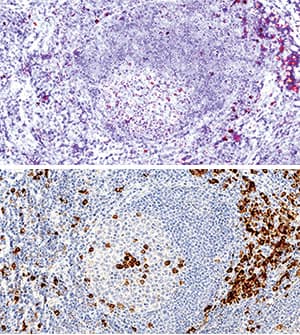
Scientific images may be resized, cropped, or adjusted for brightness or contrast for presentation purposes. These updates are limited to presentation and do not affect the underlying scientific interpretation of the data. Where available, additional source data may be provided upon request.
Conjugate
Catalog #
Key Product Details
Validated by
Orthogonal Validation, Biological Validation
Species Reactivity
Validated:
Human
Cited:
Human, Mouse
Applications
Validated:
Immunohistochemistry, ELISA Capture (Matched Antibody Pair), Neutralization, Flow Cytometry, Dual RNAscope ISH-IHC Compatible, CyTOF-ready
Cited:
Immunohistochemistry, Immunohistochemistry-Paraffin, Western Blot, Neutralization, Flow Cytometry, Immunocytochemistry, ELISA Capture, ELISA Development (Detection), Functional Assay, T Cell Activation
Label
Unconjugated
Antibody Source
Monoclonal Mouse IgG1 Clone # 37711
Product Specifications
Immunogen
S. frugiperda insect ovarian cell line Sf 21-derived recombinant human B7‑1/CD80
Val35-Asn242 (predicted)
Accession # P33681
Val35-Asn242 (predicted)
Accession # P33681
Specificity
Detects human B7‑1/CD80 in ELISAs. In sandwich immunoassays, no cross-reactivity or interference with recombinant human (rh) B7-2, recombinant mouse (rm) B7-1, rmB7-2, rhB7-H1, rhB7-H2, rhB7-H3 or rmPD-L2 is observed.
Clonality
Monoclonal
Host
Mouse
Isotype
IgG1
Endotoxin Level
<0.10 EU per 1 μg of the antibody by the LAL method.
Scientific Data Images for Human B7-1/CD80 Antibody
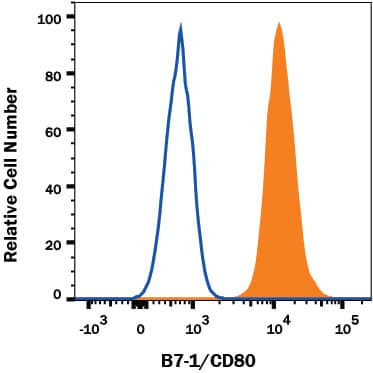
Detection of B7-1/CD80 in Raji Human Cell Line by Flow Cytometry.
Raji human Burkitt's lymphoma cell line was stained with Mouse Anti-Human B7-1/CD80 Monoclonal Antibody (Catalog # MAB140, filled histogram) or isotype control antibody (Catalog # MAB002, open histogram), followed by Fluorescein-conjugated Anti-Mouse IgG Secondary Antibody (Catalog # F0103B). View our protocol for Staining Membrane-associated Proteins.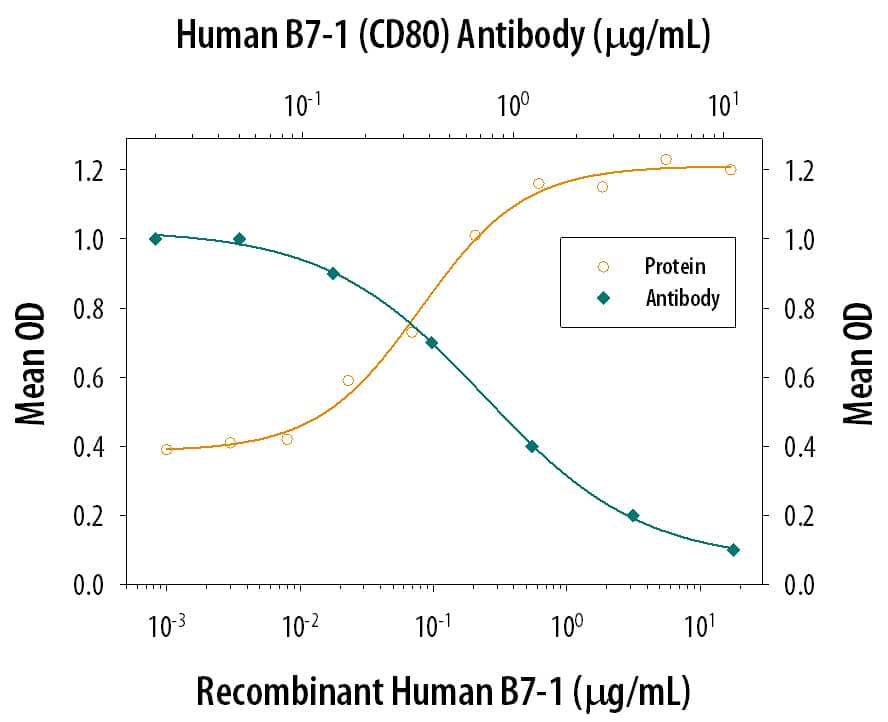
IL‑2 secretion Induced by B7‑1/CD80 and Neutralization by Human B7‑1/CD80 Antibody.
Recombinant Human B7-1/CD80 Fc Chimera (Catalog # 140-B1) co-stimulates IL-2 secretion in the Jurkat human acute T cell leukemia cell line in the presence of PHA in a dose-dependent manner (orange line), as measured by the Human IL-2 Quantikine ELISA Kit (Catalog # D2050). IL-2 secretion elicited by Recombinant Human B7-1/CD80 Fc Chimera (1 µg/mL) and PHA (10 µg/mL) is neutralized (green line) by increasing concentrations of Mouse Anti-Human B7-1/CD80 Monoclonal Antibody (Catalog # MAB140). The ND50 is typically 0.2-1 µg/mL.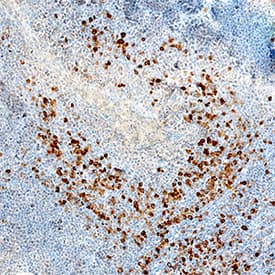
B7‑1/CD80 in Human Tonsil.
B7-1/CD80 was detected in immersion fixed paraffin-embedded sections of human tonsil using Mouse Anti-Human B7-1/CD80 Monoclonal Antibody (Catalog # MAB140) at 5 µg/mL overnight at 4 °C. Tissue was stained using the Anti-Mouse HRP-DAB Cell & Tissue Staining Kit (brown; Catalog # CTS002) and counterstained with hematoxylin (blue). Specific staining was localized to cytoplasm in lymphocytes. View our protocol for Chromogenic IHC Staining of Paraffin-embedded Tissue Sections.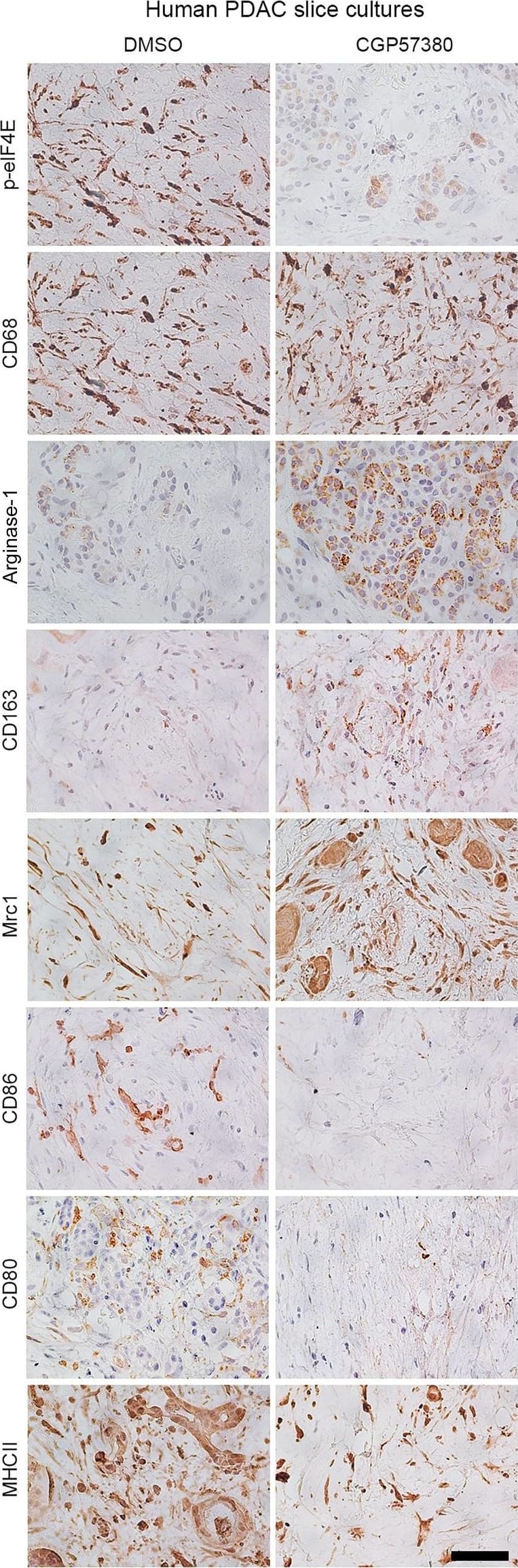

Applications for Human B7-1/CD80 Antibody
Application
Recommended Usage
CyTOF-ready
Ready to be labeled using established conjugation methods. No BSA or other carrier proteins that could interfere with conjugation.
Dual RNAscope ISH-IHC Compatible
5-25 µg/mL
Sample: Immersion fixed paraffin-embedded sections of human tonsil tissue
Sample: Immersion fixed paraffin-embedded sections of human tonsil tissue
Flow Cytometry
0.25 µg/106 cells
Sample: Raji human Burkitt's lymphoma cell line
Sample: Raji human Burkitt's lymphoma cell line
Immunohistochemistry
5-25 µg/mL
Sample: Immersion fixed paraffin-embedded sections of human tonsil tissue
Sample: Immersion fixed paraffin-embedded sections of human tonsil tissue
Neutralization
Measured by its ability to neutralize B7‑1/CD80 and PHA-induced IL‑2 secretion in the Jurkat human acute T cell leukemia cell line. The Neutralization Dose (ND50) is typically 0.2-1 µg/mL in the presence of 1 µg/mL Recombinant Human B7‑1/CD80 Fc Chimera and 10 µg/mL PHA.
Human B7-1/CD80 Sandwich Immunoassay
Please Note: Optimal dilutions of this antibody should be experimentally determined.
Reviewed Applications
Read 2 reviews rated 3.5 using MAB140 in the following applications:
Formulation, Preparation, and Storage
Purification
Protein A or G purified from hybridoma culture supernatant
Reconstitution
Reconstitute at 0.5 mg/mL in sterile PBS. For liquid material, refer to CoA for concentration.
Formulation
Lyophilized from a 0.2 μm filtered solution in PBS with Trehalose. *Small pack size (SP) is supplied either lyophilized or as a 0.2 µm filtered solution in PBS.
Shipping
Lyophilized product is shipped at ambient temperature. Liquid small pack size (-SP) is shipped with polar packs. Upon receipt, store immediately at the temperature recommended below.
Stability & Storage
Use a manual defrost freezer and avoid repeated freeze-thaw cycles.
- 12 months from date of receipt, -20 to -70 °C as supplied.
- 1 month, 2 to 8 °C under sterile conditions after reconstitution.
- 6 months, -20 to -70 °C under sterile conditions after reconstitution.
Background: B7-1/CD80
B7-1 and B7-2, together with their receptors CD28 and CTLA-4, constitute one of the dominant co-stimulatory pathways that regulate T- and B-cell responses. Although both CTLA-4 and CD28 can bind to the same ligands, CTLA-4 binds to B7-1 and B7-2 with a 20‑100 fold higher affinity than CD28 and is involved in the down‑regulation of the immune response. B7-1 is expressed on activated B cells, activated T cells, and macrophages. B7-2 is constitutively expressed on interdigitating dendritic cells, Langerhans cells, peripheral blood dendritic cells, memory B cells, and germinal center B cells. Additionally, B7-2 is expressed at low levels on monocytes and can be up‑regulated through Interferon gamma. B7-1 and B7-2 are both members of the Immunoglobulin superfamily. Human B7-1 is a 288 amino acid (aa) protein containing a 34 aa signal peptide, a 208 aa extracellular domain, a 21 aa transmembrane domain, and a 25 aa cytoplasmic domain. Human B7-1 and B7-2 share 26% aa sequenceidentity. Human and mouse B7-1 share 44% aa sequenceidentity. However, it has been observed that both human and mouse B7-1 and B7-2 can bind to either human or mouse CD28 and CTLA-4, suggesting that there are conserved amino acids which form the B7-1/B7-2/CD28/CTLA-4 critical binding sites.
References
- Azuma, M. et al. (1993) Nature 366:76.
- Freeman, G.J. et al. (1993) Science 262:909.
- Freeman, G. et al. (1991) J. Exp. Med. 174:625.
- Selvakumar, A. et al. (1993) Immunogenetics 38:292.
- Chen, C. et al. (1994) J. Immunol. 152:4929.
- Freeman, G.J. et al. (1993) J. Exp. Med. 178:2185.
Alternate Names
B71, CD80
Gene Symbol
CD80
UniProt
Additional B7-1/CD80 Products
Product Documents for Human B7-1/CD80 Antibody
Product Specific Notices for Human B7-1/CD80 Antibody
For research use only
Loading...
Loading...
Loading...
Loading...
Loading...
Loading...