
Human AGTR-1 Antibody
R&D Systems, part of Bio-Techne | Catalog # MAB102441

Scientific images may be resized, cropped, or adjusted for brightness or contrast for presentation purposes. These updates are limited to presentation and do not affect the underlying scientific interpretation of the data. Where available, additional source data may be provided upon request.
Conjugate
Catalog #
Key Product Details
Species Reactivity
Human
Applications
Western Blot
Label
Unconjugated
Antibody Source
Monoclonal Mouse IgG2B Clone # 1010106
Product Specifications
Immunogen
Synthetic peptide containing human AGTR-1
Accession # P30556
Accession # P30556
Specificity
Detects human AGTR-1 in direct ELISAs and Western blots.
Clonality
Monoclonal
Host
Mouse
Isotype
IgG2B
Scientific Data Images for Human AGTR-1 Antibody
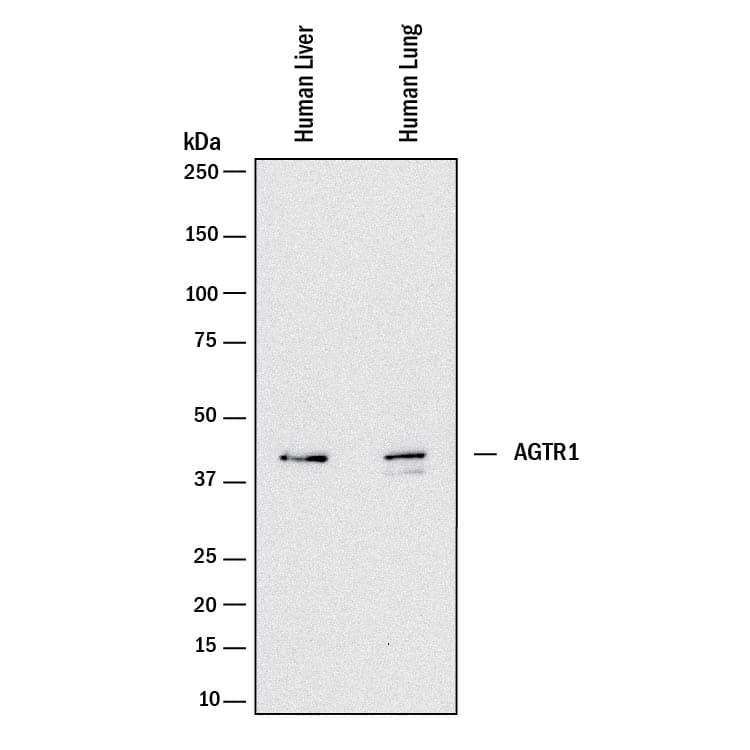
Detection of Human AGTR‑1 by Western Blot.
Western blot shows lysates of human liver tissue and human lung tissue. PVDF membrane was probed with 1 µg/mL of Mouse Anti-Human AGTR-1 Monoclonal Antibody (Catalog # MAB102441) followed by HRP-conjugated Anti-Mouse IgG Secondary Antibody (HAF018). A specific band was detected for AGTR-1 at approximately 43 kDa (as indicated). This experiment was conducted under reducing conditions and using Immunoblot Buffer Group 1.
Detection of AGTR-1 by Immunohistochemistry
Obesity leads to renal tubule injury and RAS activation in humans and mice. (A–C) Representative images (A), body weight curves (B), and bodyweight levels after 18 weeks (C), of obese and lean mice. (D,E) Representative immunohistochemical staining of AGT, AT1, KIM1, and NGAL in kidney sections of lean and obese mice (Original magnification 200×). AGT, angiotensinogen; AT1, angiotensin 1; KIM-1, kidney injury molecule-1; NGAL, neutrophil gelatinase-associated lipocalin. *P < 0.001; ***P < 0.05. Image collected and cropped by CiteAb from the following open publication (https://pubmed.ncbi.nlm.nih.gov/34568382), licensed under a CC-BY license. Not internally tested by R&D Systems.Applications for Human AGTR-1 Antibody
Application
Recommended Usage
Western Blot
1 µg/mL
Sample: Human liver tissue and Human lung tissue
Sample: Human liver tissue and Human lung tissue
Formulation, Preparation, and Storage
Purification
Protein A or G purified from hybridoma culture supernatant
Reconstitution
Reconstitute at 0.5 mg/mL in sterile PBS. For liquid material, refer to CoA for concentration.
Formulation
Lyophilized from a 0.2 μm filtered solution in PBS with Trehalose. *Small pack size (SP) is supplied either lyophilized or as a 0.2 µm filtered solution in PBS.
Shipping
Lyophilized product is shipped at ambient temperature. Liquid small pack size (-SP) is shipped with polar packs. Upon receipt, store immediately at the temperature recommended below.
Stability & Storage
Use a manual defrost freezer and avoid repeated freeze-thaw cycles.
- 12 months from date of receipt, -20 to -70 °C as supplied.
- 1 month, 2 to 8 °C under sterile conditions after reconstitution.
- 6 months, -20 to -70 °C under sterile conditions after reconstitution.
Background: AGTR-1
Type-1 angiotensin II receptor, AGTR1, is a seven transmembrane domain (7TM) G protein-coupled receptor (GPCR) that mediates the cardiovascular effects of angiotensin II. At least four transcript variants have been described for the AGTR1 gene.
Long Name
Angiotensin II Receptor Type 1
Alternate Names
AG2S, AGTR1, AT1, AT1AR, AT1BR, AT1R, AT2R1
Gene Symbol
AGTR1
UniProt
Additional AGTR-1 Products
Product Documents for Human AGTR-1 Antibody
Product Specific Notices for Human AGTR-1 Antibody
For research use only
Loading...
Loading...
Loading...
Loading...
Loading...