
FGF basic/FGF2/bFGF Antibody - Azide and BSA Free
Novus Biologicals, part of Bio-Techne | Catalog # NB600-1536

Scientific images may be resized, cropped, or adjusted for brightness or contrast for presentation purposes. These updates are limited to presentation and do not affect the underlying scientific interpretation of the data. Where available, additional source data may be provided upon request.
Key Product Details
Species Reactivity
Validated:
Human, Rat, Bovine, Equine
Cited:
Human, Rat, Equine
Applications
Validated:
Immunohistochemistry, Immunohistochemistry-Paraffin, Western Blot, ELISA
Cited:
Immunohistochemistry-Paraffin, ELISA
Label
Unconjugated
Antibody Source
Polyclonal Rabbit IgG
Format
Azide and BSA Free
Concentration
LYOPH mg/ml
Product Specifications
Immunogen
Synthetic peptide conjugated to KLH, corresponding to amino acids 1-24 of Cow FGF2.
Reactivity Notes
Equine reactivity reported in scientific literature (PMID: 24035195).
Specificity
Does not cross react with bovine FGF Acidic or bovine serum albumin.
Clonality
Polyclonal
Host
Rabbit
Isotype
IgG
Scientific Data Images for FGF basic/FGF2/bFGF Antibody - Azide and BSA Free
Immunohistochemistry: FGF basic/FGF2/bFGF Antibody - Azide and BSA Free [NB600-1536] -
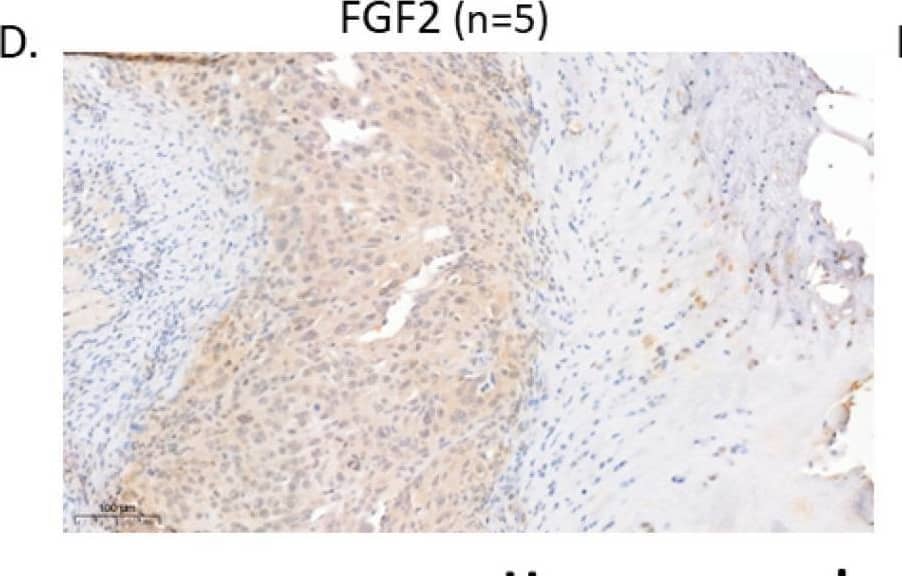
High VEGF-A and FGF2 labeling levels in an orthotopic OS mouse model and in human lung metastasis specimens: (A) U2-OS tumor image at 5 weeks and (B) anti-VEGF-A immunolabeling. Representative images of primary OS tumors in mice and nearby bone. The labeling pattern was mainly cytoplasmic; however, nuclear labeling was also noticed. Images were obtained under a ×40 magnification. Scale bar denotes 50 um. (C) Quantitative analysis of immunolabeled area (tumor/bone ratio) of primary OS tumors in mice normalized to nearby bone. Primary OS tumors exhibit significantly higher VEGF-A levels compared to control bone; *** p < 0.001. (D) FGF2 immunolabeling. Representative images of primary OS tumors in mice and nearby bone. Images were obtained under ×40 magnification. Scale bar denotes 50 um. (E) Quantitative analysis of immunolabeled area (tumor/bone ratio) of primary OS tumors in mice normalized to nearby bone. Primary OS tumors exhibit significantly higher FGF2 levels compared to control bone; ** p < 0.01. (F) Representative anti-VEGF-A and anti-FGF2 immunolabeling of human metastatic OS and non-metastatic OS patient specimens. Images showing nuclear labeling pattern. Microscope images were obtained under ×40 magnification. Scale bar denotes 50 um. (G) Quantitative analysis of immunolabeled area (1/um2) in metastatic vs. non-metastatic human OS specimens. Higher levels of VEGF-A (primary, N = 7; metastasis, N = 8) and FGF2 (primary, N = 6; metastasis, N = 14) were obtained in metastatic samples compared to primary tumors; * p < 0.05, and **** p < 0.0001. Image collected and cropped by CiteAb from the following open publication (https://www.mdpi.com/2072-6694/15/6/1818), licensed under a CC-BY license. Not internally tested by Novus Biologicals.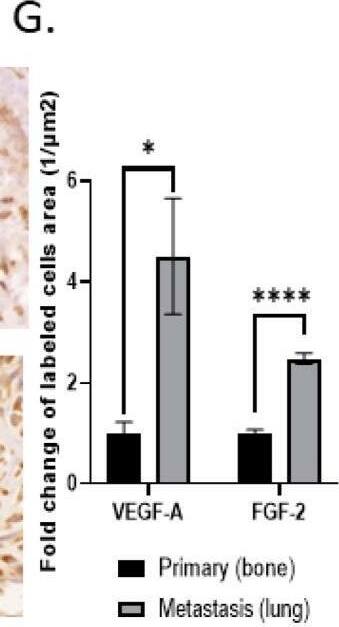
Immunohistochemistry: FGF basic/FGF2/bFGF Antibody - Azide and BSA Free [NB600-1536] -
High VEGF-A and FGF2 labeling levels in an orthotopic OS mouse model and in human lung metastasis specimens: (A) U2-OS tumor image at 5 weeks and (B) anti-VEGF-A immunolabeling. Representative images of primary OS tumors in mice and nearby bone. The labeling pattern was mainly cytoplasmic; however, nuclear labeling was also noticed. Images were obtained under a ×40 magnification. Scale bar denotes 50 um. (C) Quantitative analysis of immunolabeled area (tumor/bone ratio) of primary OS tumors in mice normalized to nearby bone. Primary OS tumors exhibit significantly higher VEGF-A levels compared to control bone; *** p < 0.001. (D) FGF2 immunolabeling. Representative images of primary OS tumors in mice and nearby bone. Images were obtained under ×40 magnification. Scale bar denotes 50 um. (E) Quantitative analysis of immunolabeled area (tumor/bone ratio) of primary OS tumors in mice normalized to nearby bone. Primary OS tumors exhibit significantly higher FGF2 levels compared to control bone; ** p < 0.01. (F) Representative anti-VEGF-A and anti-FGF2 immunolabeling of human metastatic OS and non-metastatic OS patient specimens. Images showing nuclear labeling pattern. Microscope images were obtained under ×40 magnification. Scale bar denotes 50 um. (G) Quantitative analysis of immunolabeled area (1/um2) in metastatic vs. non-metastatic human OS specimens. Higher levels of VEGF-A (primary, N = 7; metastasis, N = 8) and FGF2 (primary, N = 6; metastasis, N = 14) were obtained in metastatic samples compared to primary tumors; * p < 0.05, and **** p < 0.0001. Image collected and cropped by CiteAb from the following open publication (https://www.mdpi.com/2072-6694/15/6/1818), licensed under a CC-BY license. Not internally tested by Novus Biologicals.Applications for FGF basic/FGF2/bFGF Antibody - Azide and BSA Free
Application
Recommended Usage
ELISA
indirect
Immunohistochemistry
1:10-1:500
Immunohistochemistry-Paraffin
1:10-1:500
Western Blot
1:1000
Application Notes
Bioactivity: Anti-FGF basic (1-24) was tested in cell culture using fetal bovine heart endothelial cells (ATCC CRL 1395) plated at low cell density. Various dilutions of Anti-FGF basic(1-24) were pre incubated at 37 C with FGF basic or FGF acidic for 2 hours. Anti-FGF basic (1-24) caused a dose-dependent decrease in the mitogenic activity of FGF basic such that a final dilution of 1:50 neutralized the bioactivity of 1 unit of FGF basic.
Formulation, Preparation, and Storage
Purification
Sterile filtered
Reconstitution
For the 0.1ml size we recommend reconstitution with 0.1ml deionized water. Rotate vial gently until powder dissolves. The 0.025ml size is provided in liquid format.
Formulation
Lyophilized from 0.2 um filtered solution in 10mM PBS (pH 7.2)
Format
Azide and BSA Free
Preservative
No Preservative
Concentration
LYOPH mg/ml
Shipping
The product is shipped with polar packs. Upon receipt, store it immediately at the temperature recommended below.
Stability & Storage
Store at 4C short term. Aliquot and store at -20C long term. Avoid freeze-thaw cycles.
Background: FGF basic/FGF2/bFGF
FGF basic/FGF2/bFGF is a growth factor that functions in angiogenesis, wound healing, tissue repair, learning and memory, and the morphogenesis of heart, bone, and brain. It is upregulated in response to inflammatory stimuli and in many tumors. FGF basic/FGF2/bFGF binds to FGFR1c and 2c. Its bioactivity is modulated by a number of other binding partners including heparin, Integrin alpha V beta 3, soluble FGFR1, FGF-BP, free gangliosides, Thrombospondin, Pentraxin 3/TSG-14, Fibrinogen, alpha 2-Macroglobulin, PDGF, and CXCL4/PF4. These molecules act as cellular coreceptors or adhesion partners, extracellular matrix decoys or reservoirs, and soluble scavengers or chaperones. In particular, the interaction of FGF basic/FGF2/bFGF with cell surface heparan sulfate proteoglycans (HSPG) is required for the binding and activation of FGF receptors.
Long Name
Fibroblast Growth Factor basic
Alternate Names
bFGF, FGF-2, FGF2, HBGF-2, Prostatropin
Gene Symbol
FGF2
UniProt
Additional FGF basic/FGF2/bFGF Products
Product Documents for FGF basic/FGF2/bFGF Antibody - Azide and BSA Free
Product Specific Notices for FGF basic/FGF2/bFGF Antibody - Azide and BSA Free
This product is for research use only and is not approved for use in humans or in clinical diagnosis. Primary Antibodies are guaranteed for 1 year from date of receipt.
Loading...
Loading...
Loading...
Loading...
Loading...
Loading...