
CD38 Antibody (PD01-49)
Novus Biologicals, part of Bio-Techne | Catalog # NBP3-32151
Recombinant Monoclonal Antibody

![CD38 Antibody (PD01-49) Western Blot: CD38 Antibody (PD01-49) [NBP3-32151]](https://resources.bio-techne.com/images/products/nbp3-32151_-western-blot-639204594552926229.jpg "Western Blot: CD38 Antibody (PD01-49) [NBP3-32151]")
Key Product Details
Species Reactivity
Human, Mouse, Rat
Applications
Multiplex Immunofluorescence, Immunohistochemistry, Immunohistochemistry-Paraffin, Western Blot, Flow Cytometry, Immunocytochemistry/ Immunofluorescence
Label
Unconjugated
Antibody Source
Recombinant Monoclonal Rabbit IgG Clone # PD01-49 expressed in HEK293
Concentration
1 mg/ml
Product Specifications
Immunogen
Synthetic peptide within human CD38 aa 250-300. (Uniprot: P28907)
Localization
Membrane.
Clonality
Monoclonal
Host
Rabbit
Isotype
IgG
Theoretical MW
34 kDa.
Disclaimer note: The observed molecular weight of the protein may vary from the listed predicted molecular weight due to post translational modifications, post translation cleavages, relative charges, and other experimental factors.
Disclaimer note: The observed molecular weight of the protein may vary from the listed predicted molecular weight due to post translational modifications, post translation cleavages, relative charges, and other experimental factors.
Scientific Data Images for CD38 Antibody (PD01-49)
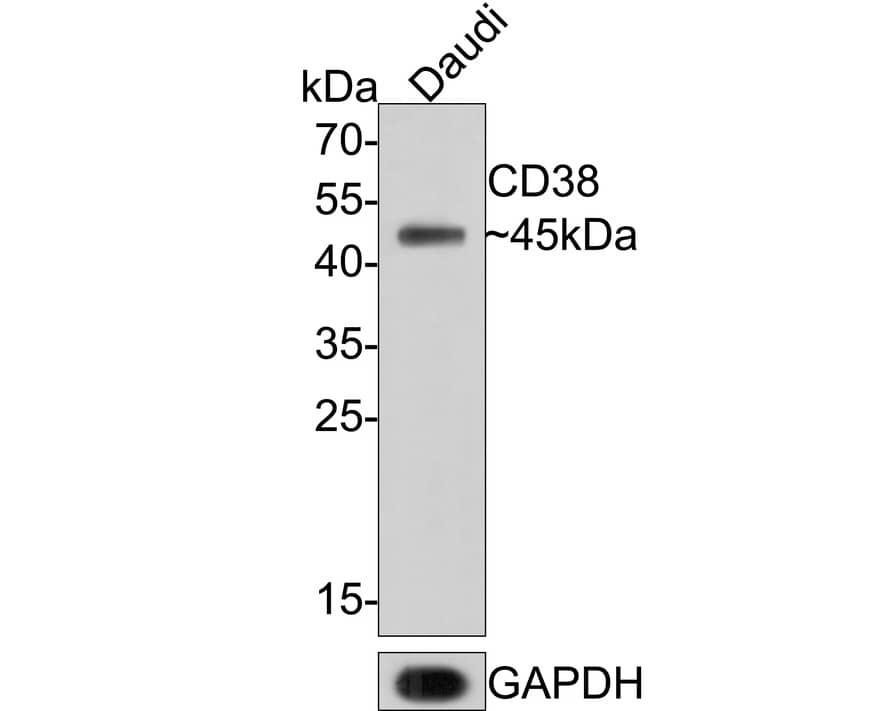
Western Blot: CD38 Antibody (PD01-49) [NBP3-32151]
Western Blot: CD38 Antibody (PD01-49) [NBP3-32151] - Western blot analysis of CD38 on Daudi cell lysates with Rabbit anti-CD38 antibody (NBP3-32151) at 1/1,000 dilution.Lysates/proteins at 10 ug/Lane.
Predicted band size: 34 kDa
Observed band size: 45 kDa
Exposure time: 2 minutes;
12% SDS-PAGE gel.
Proteins were transferred to a PVDF membrane and blocked with 5% NFDM/TBST for 1 hour at room temperature. The primary antibody (NBP3-32151) at 1/1,000 dilution was used in 5% NFDM/TBST at room temperature for 2 hours. Goat Anti-Rabbit IgG - HRP Secondary Antibody at 1:300,000 dilution was used for 1 hour at room temperature.
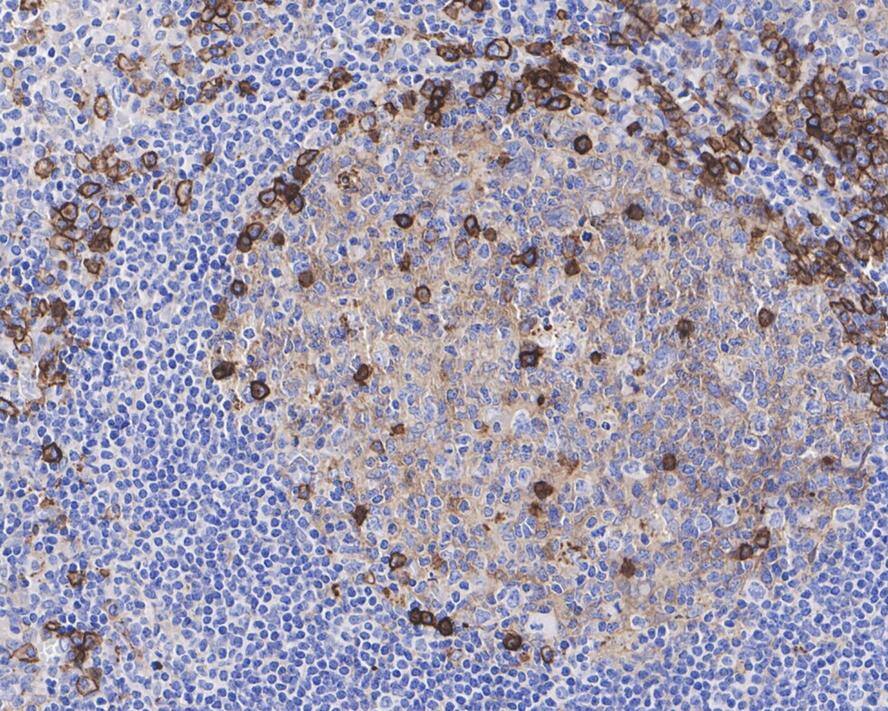
Immunohistochemistry: CD38 Antibody (PD01-49) [NBP3-32151]
Immunohistochemistry: CD38 Antibody (PD01-49) [NBP3-32151] - Immunohistochemical analysis of paraffin-embedded human tonsil tissue with Rabbit anti-CD38 antibody (NBP3-32151) at 1/2,000 dilution.The section was pre-treated using heat mediated antigen retrieval with Tris-EDTA buffer (pH 9.0) for 20 minutes. The tissues were blocked in 1% BSA for 20 minutes at room temperature, washed with ddH2O and PBS, and then probed with the primary antibody (NBP3-32151) at 1/2,000 dilution for 1 hour at room temperature. The detection was performed using an HRP conjugated compact polymer system. DAB was used as the chromogen. Tissues were counterstained with hematoxylin and mounted with DPX.
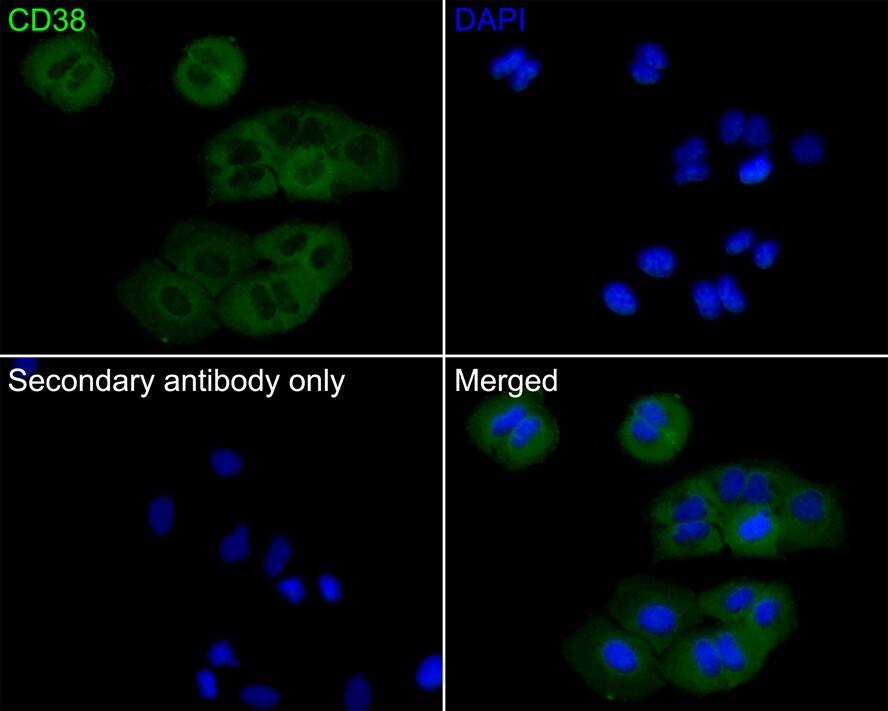
Immunocytochemistry/ Immunofluorescence: CD38 Antibody (PD01-49) [NBP3-32151]
Immunocytochemistry/ Immunofluorescence: CD38 Antibody (PD01-49) [NBP3-32151] - Immunocytochemistry analysis of A549 cells labeling CD38 with Rabbit anti-CD38 antibody (NBP3-32151) at 1/50 dilution.Cells were fixed in 4% paraformaldehyde for 10 minutes at 37 ℃, permeabilized with 0.05% Triton X-100 in PBS for 20 minutes, and then blocked with 2% negative goat serum for 30 minutes at room temperature. Cells were then incubated with Rabbit anti-CD38 antibody (NBP3-32151) at 1/50 dilution in 2% negative goat serum overnight at 4 ℃. Goat Anti-Rabbit IgG H&L (iFluor™ 488) was used as the secondary antibody at 1/1,000 dilution. PBS instead of the primary antibody was used as the secondary antibody only control. Nuclear DNA was labelled in blue with DAPI.
Applications for CD38 Antibody (PD01-49)
Application
Recommended Usage
Flow Cytometry
1:1000
Immunocytochemistry/ Immunofluorescence
1:50
Immunohistochemistry-Paraffin
1:1000
Western Blot
1:1000
Application Notes
Recommended dilution for Multiplex IHC: 1:1000
Formulation, Preparation, and Storage
Purification
Protein A purified
Formulation
PBS (pH7.4), 0.1% BSA and 40% Glycerol
Preservative
0.05% Sodium Azide
Concentration
1 mg/ml
Shipping
The product is shipped with polar packs. Upon receipt, store it immediately at the temperature recommended below.
Stability & Storage
Store at 4C short term. Aliquot and store at -20C long term. Avoid freeze-thaw cycles.
Background: CD38
As described above, CD38 is highly expressed in plasma cells and, as a result, is a target for treating multiple myeloma (MM), the cancer of white blood cells (4,6). The anti-CD38 monoclonal antibody daratumumab is one specific treatment for MM (4,6). Daratumumab has been shown to target MM cells through antibody-dependent cellular cytotoxicity and antibody dependent cellular phagocytosis (4). Additionally, CD38 has a potential role in neurodegenerative disorders and neuroinflammation as elucidated CD38's high expression in neurons, astrocytes, and microglia along with its enzymatic role in NAD degradation (3). Reduced NAD levels is a consequence of aging and occurs during neurodegeneration (3). Furthermore, murine studies have found that CD38 deletion inhibits neuroinflammation and neurodegeneration and therefore might be a potential therapeutic target (3). Similarly, CD38 inhibitors, like quercetin and luteolin, are used to treat age-related diseases and metabolic disorders (7).
References
1. Malavasi, F., Funaro, A., Alessio, M., DeMonte, L. B., Ausiello, C. M., Dianzani, U., Lanza, F., Magrini, E., Momo, M., & Roggero, S. (1992). CD38: a multi-lineage cell activation molecule with a split personality. International journal of clinical & laboratory research. https://doi.org/10.1007/BF02591400
2. Malavasi, F., Deaglio, S., Funaro, A., Ferrero, E., Horenstein, A. L., Ortolan, E., Vaisitti, T., & Aydin, S. (2008). Evolution and function of the ADP ribosyl cyclase/CD38 gene family in physiology and pathology. Physiological reviews. https://doi.org/10.1152/physrev.00035.2007
3. Guerreiro, S., Privat, A. L., Bressac, L., & Toulorge, D. (2020). CD38 in Neurodegeneration and Neuroinflammation. Cells. https://doi.org/10.3390/cells9020471
4. van de Donk, N., Richardson, P. G., & Malavasi, F. (2018). CD38 antibodies in multiple myeloma: back to the future. Blood. https://doi.org/10.1182/blood-2017-06-740944
5. Lund, F. E., Cockayne, D. A., Randall, T. D., Solvason, N., Schuber, F., & Howard, M. C. (1998). CD38: a new paradigm in lymphocyte activation and signal transduction. Immunological reviews. https://doi.org/10.1111/j.1600-065x.1998.tb01573.x
6. Glaria, E., & Valledor, A. F. (2020). Roles of CD38 in the Immune Response to Infection. Cells. https://doi.org/10.3390/cells9010228
7. Rajman, L., Chwalek, K., & Sinclair, D. A. (2018). Therapeutic Potential of NAD-Boosting Molecules: The In Vivo Evidence. Cell metabolism. https://doi.org/10.1016/j.cmet.2018.02.011
Long Name
Cluster of Differentiation 38
Alternate Names
ADP-ribosyl Cyclase, CD38, Cyclic ADP-ribose Hydrolase
Gene Symbol
CD38
Additional CD38 Products
Product Documents for CD38 Antibody (PD01-49)
Product Specific Notices for CD38 Antibody (PD01-49)
This product is for research use only and is not approved for use in humans or in clinical diagnosis. Primary Antibodies are guaranteed for 1 year from date of receipt.
Loading...
Loading...
Loading...
Loading...
Loading...
Loading...