
B7-2/CD86 Antibody (C86/2160R) - Azide and BSA Free
Novus Biologicals, part of Bio-Techne | Catalog # NBP3-49567
Recombinant Monoclonal Antibody

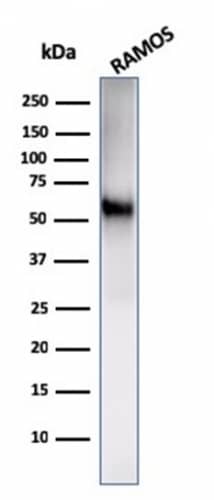
Key Product Details
Species Reactivity
Human
Applications
Immunohistochemistry, Western Blot, ELISA, Flow Cytometry, Immunocytochemistry/ Immunofluorescence
Label
Unconjugated
Antibody Source
Recombinant Monoclonal Rabbit IgG Kappa Clone # C86/2160R
Format
Azide and BSA Free
Concentration
Please see the vial label for concentration. If unlisted please contact technical services.
Product Specifications
Immunogen
Recombinant human full-length CD86 protein (Uniprot: P42081)
Localization
Cytoplasm, Endoplasmic reticulum, Microsome, Nucleus
Clonality
Monoclonal
Host
Rabbit
Isotype
IgG Kappa
Theoretical MW
70 kDa.
Disclaimer note: The observed molecular weight of the protein may vary from the listed predicted molecular weight due to post translational modifications, post translation cleavages, relative charges, and other experimental factors.
Disclaimer note: The observed molecular weight of the protein may vary from the listed predicted molecular weight due to post translational modifications, post translation cleavages, relative charges, and other experimental factors.
Description
Prepared in 10mM PBS WITHOUT BSA & azide at 1.0mg/ml. Also available with 0.05% BSA & 0.05% azide.
Antibody with azide - store at 2 to 8 C. Antibody without azide - store at -20 to -80 C. Antibody is stable for 24 months. Non-hazardous.
Antibody with azide - store at 2 to 8 C. Antibody without azide - store at -20 to -80 C. Antibody is stable for 24 months. Non-hazardous.
Scientific Data Images for B7-2/CD86 Antibody (C86/2160R) - Azide and BSA Free
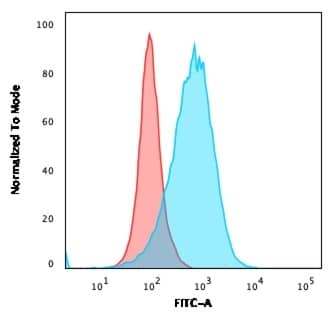
Flow Cytometry: B7-2/CD86 Antibody (C86/2160R) - Azide and BSA Free [NBP3-49567] -
Flow Cytometric Analysis of Ramos cells using B7-2/CD86 Antibody (C86/2160R) - Azide and BSA Free followed by goat anti-Mouse IgG-CF488 (Blue); Isotype Control (Red).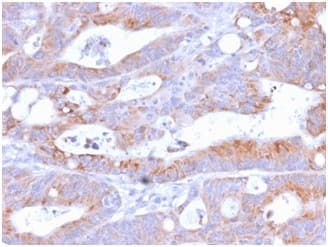
Immunohistochemistry-Paraffin: B7-2/CD86 Antibody (C86/2160R) - Azide and BSA Free [NBP3-49567] -
Formalin-fixed, paraffin-embedded human Colon stained with B7-2/CD86 Antibody (C86/2160R) - Azide and BSA Free.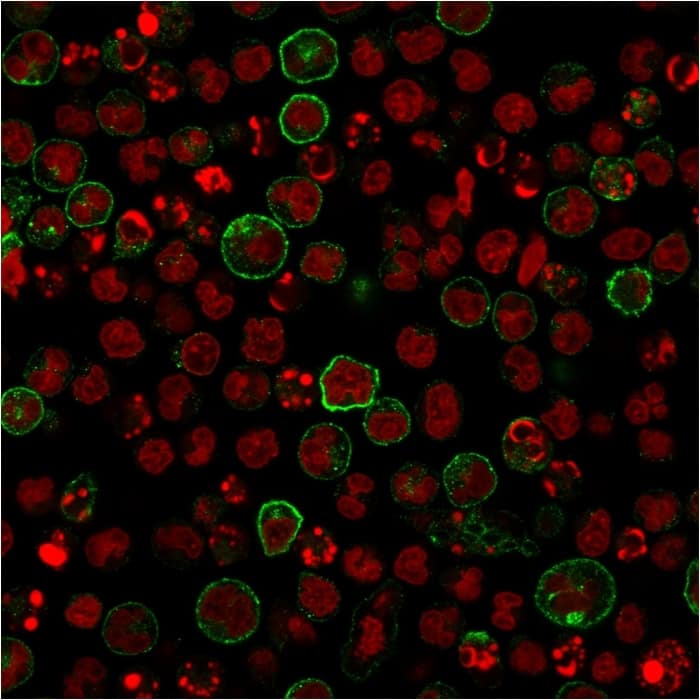
Immunocytochemistry/ Immunofluorescence: B7-2/CD86 Antibody (C86/2160R) - Azide and BSA Free [NBP3-49567] -
Immunofluorescent Staining of Raji cells using B7-2/CD86 Antibody (C86/2160R) - Azide and BSA Free (C86/2160R) followed by goat anti-rabbit IgG conjugated with CF488 (green). Nuclei are stained with Red Dot.Applications for B7-2/CD86 Antibody (C86/2160R) - Azide and BSA Free
Application
Recommended Usage
ELISA
Optimal dilutions of this antibody should be experimentally determined.
Flow Cytometry
Optimal dilutions of this antibody should be experimentally determined.
Immunocytochemistry/ Immunofluorescence
Optimal dilutions of this antibody should be experimentally determined.
Immunohistochemistry
Optimal dilutions of this antibody should be experimentally determined.
Western Blot
Optimal dilutions of this antibody should be experimentally determined.
Formulation, Preparation, and Storage
Purification
Protein A or G purified
Formulation
10 mM PBS
Format
Azide and BSA Free
Preservative
No Preservative
Concentration
Please see the vial label for concentration. If unlisted please contact technical services.
Shipping
The product is shipped with polar packs. Upon receipt, store it immediately at the temperature recommended below.
Stability & Storage
Store at -20 to -80C. Avoid freeze-thaw cycles.
Background: B7-2/CD86
References
1. Collins M, Ling V, Carreno BM. The B7 family of immune-regulatory ligands. Genome Biol. 2005;6(6):223. https://doi.org/10.1186/gb-2005-6-6-223
2. Greaves P, Gribben JG. The role of B7 family molecules in hematologic malignancy. Blood. 2013;121(5):734-744. https://doi.org/10.1182/blood-2012-10-385591
3. Bolandi N, Derakhshani A, Hemmat N, et al. The Positive and Negative Immunoregulatory Role of B7 Family: Promising Novel Targets in Gastric Cancer Treatment. Int J Mol Sci. 2021;22(19):10719. https://doi.org/10.3390/ijms221910719
4. Uniprot (P42081)
5. Bhatia S, Edidin M, Almo SC, Nathenson SG. B7-1 and B7-2: similar costimulatory ligands with different biochemical, oligomeric and signaling properties. Immunol Lett. 2006;104(1-2):70-75. https://doi.org/10.1016/j.imlet.2005.11.019
6. Ohue Y, Nishikawa H. Regulatory T (Treg) cells in cancer: Can Treg cells be a new therapeutic target?. Cancer Sci. 2019;110(7):2080-2089. https://doi.org/10.1111/cas.14069
7. Chen L, Flies DB. Molecular mechanisms of T cell co-stimulation and co-inhibition [published correction appears in Nat Rev Immunol. 2013 Jul;13(7):542]. Nat Rev Immunol. 2013;13(4):227-242. https://doi.org/1010.1038/nri3405
8. Karimi A, Alilou S, Mirzaei HR. Adverse Events Following Administration of Anti-CTLA4 Antibody Ipilimumab. Front Oncol. 2021;11:624780. https://doi.org/101010.3389/fonc.2021.624780
Alternate Names
B72, CD86
Gene Symbol
CD86
Additional B7-2/CD86 Products
Product Documents for B7-2/CD86 Antibody (C86/2160R) - Azide and BSA Free
Product Specific Notices for B7-2/CD86 Antibody (C86/2160R) - Azide and BSA Free
This product is for research use only and is not approved for use in humans or in clinical diagnosis. Primary Antibodies are guaranteed for 1 year from date of receipt.
Loading...
Loading...
Loading...
Loading...
Loading...