
APOO Antibody (2F1)
Novus Biologicals, part of Bio-Techne | Catalog # NBP1-28870

Key Product Details
Species Reactivity
Validated:
Human, Mouse
Cited:
Human, Mouse
Applications
Validated:
Immunohistochemistry, Immunohistochemistry-Paraffin, Western Blot, ELISA
Cited:
Western Blot
Label
Unconjugated
Antibody Source
Monoclonal Mouse IgG1 Clone # 2F1
Concentration
This product is unpurified. The exact concentration of antibody is not quantifiable.
Product Specifications
Immunogen
Purified recombinant fragment of APOO expressed in E. Coli.
Reactivity Notes
Please note that this antibody is reactive to Mouse and derived from the same host, Mouse. Mouse-On-Mouse blocking reagent may be needed for IHC and ICC experiments to reduce high background signal. You can find these reagents under catalog numbers PK-2200-NB and MP-2400-NB. Please contact Technical Support if you have any questions.
Clonality
Monoclonal
Host
Mouse
Isotype
IgG1
Theoretical MW
22.2 kDa.
Disclaimer note: The observed molecular weight of the protein may vary from the listed predicted molecular weight due to post translational modifications, post translation cleavages, relative charges, and other experimental factors.
Disclaimer note: The observed molecular weight of the protein may vary from the listed predicted molecular weight due to post translational modifications, post translation cleavages, relative charges, and other experimental factors.
Scientific Data Images for APOO Antibody (2F1)
![Western Blot: APOO Antibody (2F1)BSA Free [NBP1-28870]](https://resources.bio-techne.com/images/products/APOO-Antibody-2F1-Western-Blot-NBP1-28870-img0002.jpg "Western Blot: APOO Antibody (2F1)BSA Free [NBP1-28870]")
Western Blot: APOO Antibody (2F1)BSA Free [NBP1-28870]
Western Blot: APOO Antibody (2F1) [NBP1-28870] - Analysis using ApoO mouse mAb against HepG2 (1) and 3T3L1(2) cell lysate.![Immunohistochemistry-Paraffin: APOO Antibody (2F1) - BSA Free [NBP1-28870]](https://resources.bio-techne.com/images/products/APOO-Antibody-2F1-Immunohistochemistry-Paraffin-NBP1-28870-img0001.jpg "Immunohistochemistry-Paraffin: APOO Antibody (2F1) - BSA Free [NBP1-28870]")
Immunohistochemistry-Paraffin: APOO Antibody (2F1) - BSA Free [NBP1-28870]
Immunohistochemistry-Paraffin: APOO Antibody (2F1) [NBP1-28870] - Analysis of human Testis tissues using ApoO mouse mAb.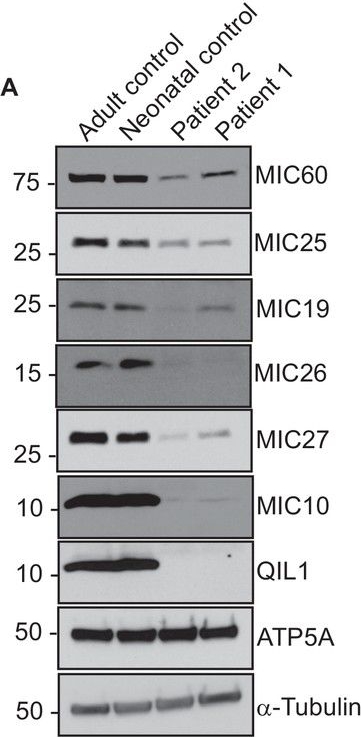
Western Blot: APOO Antibody (2F1) [NBP1-28870] -
Reduced MICOS subunit abundance and cristae morphology defects in QIL1-deficient patients’ fibroblasts.(A) Immunoblot analysis of QIL1 and various MICOS subunits in control adult skin fibroblasts, control neonatal skin fibroblasts and skin fibroblasts obtained from patients 1 and 2. Anti-ATP5A and alpha-Tubulin were used as loading controls. (B) Densitometry analysis was performed using ImageJ. Values were normalized to ATP5A. (C) qPCR analysis. Expression levels were normalized to Tubulin. (D) Electron microscopy analysis of control adult skin fibroblasts, control neonatal skin fibroblasts and skin fibroblasts from patients 1 and 2 showing enlarged mitochondria with cristae membrane swirls and proliferation of inner membranes in cells from both patients, as compared to normal mitochondria in control cells; some patients’ mitochondria contain electron dense inclusions. Morphologically abnormal mitochondria are indicated by the arrowhead. Mitochondria with cristae junctions of normal morphology are indicated with an asterisk. Quantification of abnormal mitochondria based on analysis of the indicated number of mitochondria by electron microscopy is shown. (E) Electron microscopy analysis of skeletal muscle biopsy from patient 1 showing large round mitochondria (arrowhead), which can sometimes reach the size of two sarcomeres. These large mitochondria show an important proliferation of membranes; some mitochondria contain inclusions in the form of electron dense dots. For panels B and C, asterisks represent p values<0.05. Error bars (+/- SEM) show the mean of 3 or 4 biological replicates.DOI:http://dx.doi.org/10.7554/eLife.17163.004 Image collected and cropped by CiteAb from the following open publication (https://pubmed.ncbi.nlm.nih.gov/27623147), licensed under a CC-BY license. Not internally tested by Novus Biologicals.Applications for APOO Antibody (2F1)
Application
Recommended Usage
ELISA
1:10000
Immunohistochemistry
1:10-1:500
Immunohistochemistry-Paraffin
1:200-1:1000
Western Blot
1:500-1:2000
Formulation, Preparation, and Storage
Purification
Ascites
Formulation
Ascites
Preservative
0.03% Sodium Azide
Concentration
This product is unpurified. The exact concentration of antibody is not quantifiable.
Shipping
The product is shipped with polar packs. Upon receipt, store it immediately at the temperature recommended below.
Stability & Storage
Store at 4C short term. Aliquot and store at -20C long term. Avoid freeze-thaw cycles.
Background: APOO
Alternate Names
apolipoprotein O, FAM121Bbrain my025, family with sequence similarity 121B, MGC4825, My025, MYO25, Protein FAM121B
Gene Symbol
APOO
Additional APOO Products
Product Documents for APOO Antibody (2F1)
Product Specific Notices for APOO Antibody (2F1)
This product is for research use only and is not approved for use in humans or in clinical diagnosis. Primary Antibodies are guaranteed for 1 year from date of receipt.
Loading...
Loading...
Loading...
Loading...
Loading...