
N-glycan Labeling and Detection Kit
R&D Systems, part of Bio-Techne | Catalog # EA007
100 Test per Kit

Key Product Details
Key Benefits
Learn more about Fluorescent Glycan Labeling and Detection
Species
Multi-Species
Product Summary for N-glycan Labeling and Detection Kit
The N-glycan Labeling and Detection Kit Insert (Catalog # EA007) is designed for the quick labeling and detection of N-glycans on various glycoproteins as well as studying the level of sialyation on glycoproteins. The kit provides all the necessary reagents for 100 labeling assays using the provided assay protocol. After optimization, the kit could allow for far more assays. This kit supplies Cy3-Neu5Ac Labeled ACE-2 Protein (Cy3-ACE2), with its N-glycans modified with Cy3-Neu5Ac. In addition, unlabeled Recombinant Human ACE-2 Protein (ACE2) is included as a model protein for the labeling activities of the kit. Used together they provide excellent controls for both the labeling efficiency of the kit and as a gel loading control.
N-glycan Labeling and Detection Kit
Features
- Enzymatic labeling under complete physiological conditions
- Labeling is highly specific to N-glycans
- Labeled proteins can be monitored via gel electrophoresis
- Labeled glycans can be easily released from samples by PNGase F treatment (See EA006)
- Labels can be replaced with other types of fluorophores, such as Cy5, by switching CMP-Cy3-Sialic Acid to CMP-Cy5-Syalic Acid (ES302) or biotin with CMP-C9-Biotin-Sialic Acid (ES201)
- Convenient procedure with hands on time less than 10 minutes
Preparation and Storage
Stability & Storage
Store the unopened product at -70 °C. Use a manual defrost freezer and avoid repeated freeze-thaw cycles. Do not use past expiration date.
Background: N-glycan Labeling and Detection Kit
Glycosylation is commonly found on membrane and secreted proteins of eukaryotic cells. N- and O-glycans are among the most common glycans. N-glycans refer to glycans attached to the asparagine residues in the sequon of NxS/T (Asn-X-Ser/Thr, where X can be any amino acid except Pro) of a glycoprotein. N-glycans are initiated as high-mannose glycan in endoplasmic reticulum and are converted to hybrid and complex N-glycans during the maturation process in the Golgi apparatus. In hybrid N-glycan, terminal mannose residues in one branch of the glycan are replaced with a GlcNAc residue. In complex N-glycans, all terminal mannose residues are replaced with GlcNAc residues. The GlcNAc residues are usually elongated with Gal residues that are further terminated with sialic acids. O-glycans usually refer to O-GalNAc and all its derivatives. O-glycans are initiated by attaching a single GlaNAc residue to a Ser/Thr residues on proteins via polypeptide GalNAc transferases (ppGalNAcTs). O-GalNAc can be further extended by other sugar residues and become different subtypes, such as Core-1 and Core-2 O-glycans. In some glycoproteins, glycan components can account to more than 50% of their mass. Despite the abundance, labeling and detection of these glycans are extremely difficult.
This kit offers reagents for N-glycan labeling. N-glycan specific labeling is achieved through direct incorporation of Cy3-conjugated Neu5Ac (Cy3-Neu5Ac) or replacement of existing sialic acids with Cy3-Neu5Ac via N-glycan specific sialyltransferase ST6Gal1 (Fig. 1). Following the provided Assay Protocol, the kit provides sufficient reagents to perform 100 N-glycan labeling reactions. In addition, recombinant human ACE-2 is provided as assay control and Cy3-Neu5Ac labeled recombinant human ACE-2 (Cy3-ACE-2) is provided as a gel control.
In addition to N-glycan/glycoprotein labeling and detection, the kit can also be used to evaluate sialylation levels on glycoproteins.
N-glycans can be labeled with other types of conjugated sialic acids, such as CMP-Cy5-Sialic Acid (Catalog # ES302) and CMP-C9-Sialic Acid (Catalog # ES201). Please check our website for the availability of any new activated conjugated sialic acids.
Scientific Data Images for N-glycan Labeling and Detection Kit

Strategy for N-glycan labeling.
Glycan labeling is achieved through direct incorporation of Cy3-conjugated Neu5Ac (Cy3-Neu5Ac) (A) or replacement of natural sialic acids with Cy3-Neu5Ac (B). In both strategies, Cy3-Neu5Ac is introduced via recombinant ST6Gal1. In strategy B, samples are first desialylated with recombinant C. perfringens Neuraminidase (Neu) that specifically removes alpha2-3 and alpha2-6 linked sialic acids. Alternative fluorophore conjugated Neu5Ac donor substrates and sialyltransferases may be used for the labeling.
Specific detection of N- and O-glycans on different glycoproteins.
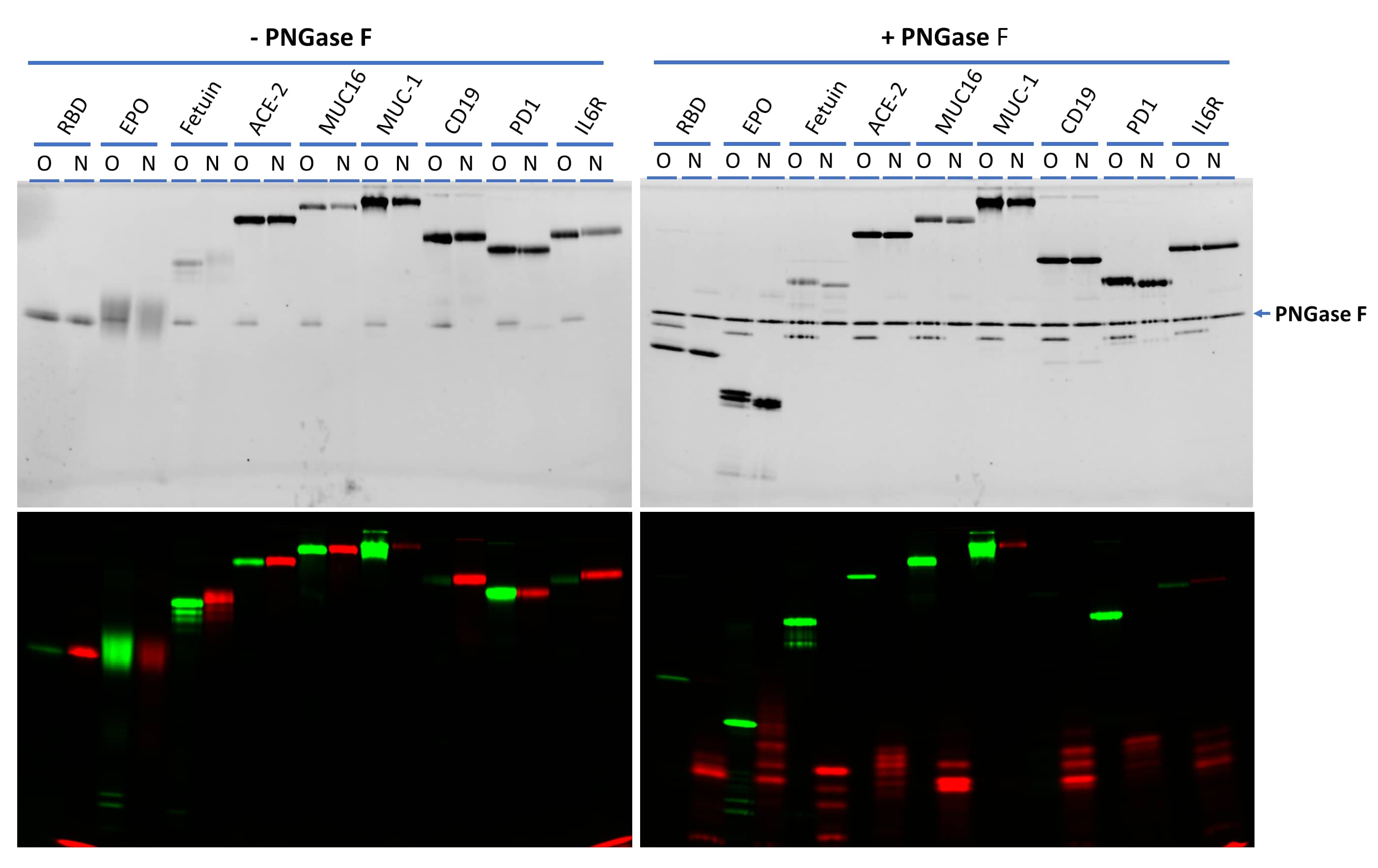
Recombinant Human CEACAM-7 Protein (9010-CM), Recombinant Human CEACAM-8/CD66b Protein (9639-CM), Recombinant Human MUC-1 Fc Chimera Protein (10332-MU), and Recombinant Human CA125/MUC16 Protein (5609-MU) were labeled on N-glycan (N) by ST6Gal1 with Cy3-Neu5Ac according to the protocol and on O-Glycan (O) by Recombinant Human ST3GAL2 Protein (7275-GT) with Cy5-Neu5Ac and then separated on 4-20% gradient SDS-PAGE gel. Only N-glycans were detected on CEACAM-7 and CEACAM-8, and only O-glycans were detected on MUC-1, both N- and O-glycans were detected on MUC16. The left part is the TCE image of the gel and the right part is the fluorescent image.
N-glycan and O-glycan specific labeling of recombinant human ACE-2.
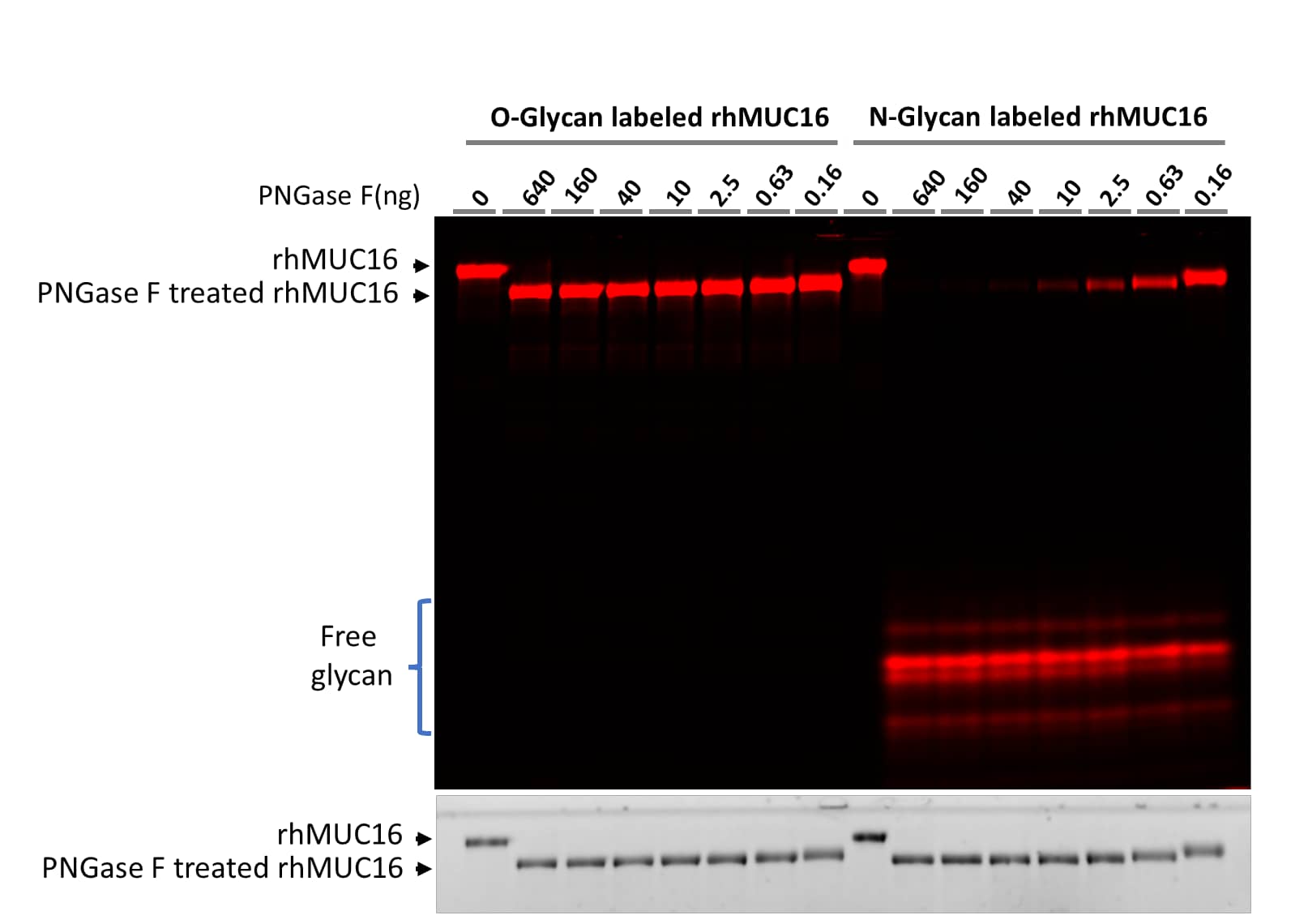
N-glycan labeled recombinant human (rh) ACE-2 was prepared according to the provided protocol and O-glycan labeled rhACE-2 was prepared in the same way except that ST6Gal1 was replaced with O-glycan specific ST3Gal2. The labeled samples were then treated with 10-fold serial dilution of PNGase F starting with 100 ng using the PNGase F N-glycan Releasing Kit (EA006). The digestions were separated on 17% SDS-PAGE gel. The upper part is the fluorescent image and the lower part is the TCE image of the gel. While all labeled N-glycans could be released by PNGase F N-glycan Releasing Kit, no labeled O-glycans were released by PNGase F, demonstrating the specific labeling on N- and O-glycans by ST6Gal1 and ST3Gal2, respectively.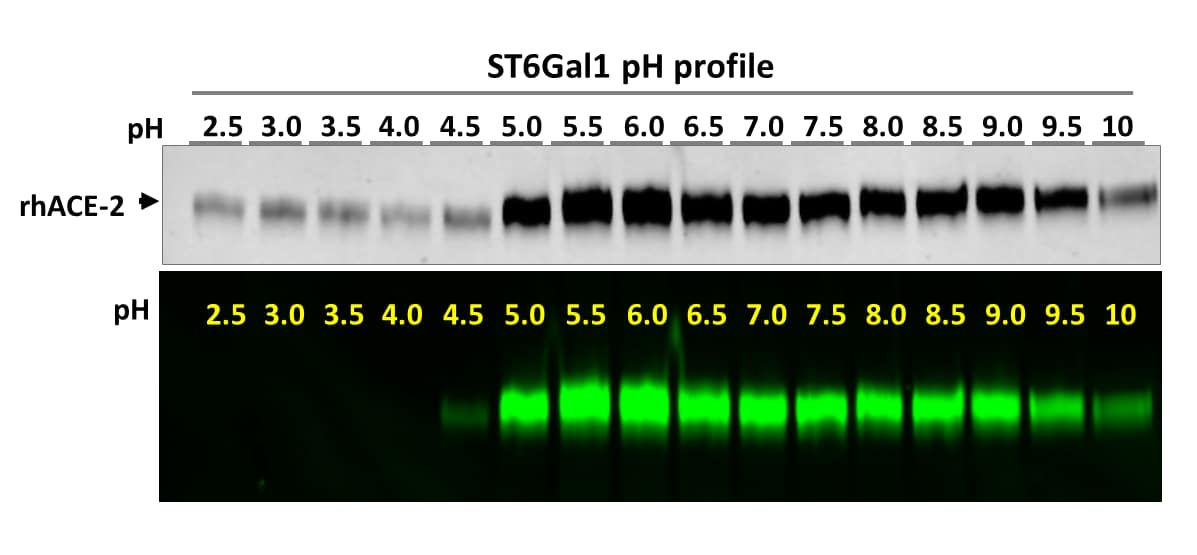

Kit Contents for N-glycan Labeling and Detection Kit
- ST6Gal1 Protein
- Neuraminidase Protein
- CMP-Cy3-Neu5Ac
- Cy3-Neu5Ac Labeled ACE-2 Protein
- ACE-2 Protein
- 6X SDS Gel Loading Dye
- Glycan Labeling Assay Buffer (10X)
Formulation, Preparation, and Storage
Shipping
The product is shipped with dry ice or equivalent. Upon receipt, store it immediately at the temperature recommended below.
Storage
Store the unopened product at -70 °C. Use a manual defrost freezer and avoid repeated freeze-thaw cycles. Do not use past expiration date.
Background: Bacterial Neuraminidase
Neuraminidase (NA) and hemagglutinin (HA) are major membrane glycoproteins found on the surface of influenza virus. HA is a lectin that binds sialic acid on host cell membrane. Neuraminidase is a sialic acid hydrolase that specifically clips off terminally located sialic acid on host cell surface. The two proteins are essential for infectious cycle of influenza virus. During initial infection, an influenza virus will hold onto an epithelial cell through HA-sialic acid interaction. At the end of an infectious cycle, the neuraminidase will cleave the sialic acid on the host cell membrane, releasing the newly formed viral particle from the HA-sialic acid bondage. The neuraminidase activity is also thought to help the virus penetrate mucus. Nine subtypes of NA have been identified, all of which are tetrameric and share a common structure consisting of a globular head, a thin stalk region, and a small hydrophobic region that anchors the protein in the virus membrane.
Additional Bacterial Neuraminidase Products
Product Documents for N-glycan Labeling and Detection Kit
Product Specific Notices for N-glycan Labeling and Detection Kit
For research use only
Loading...
Loading...
Loading...
Loading...