

Great Things Come in Small Packages: Extracellular Vesicle Capabilities
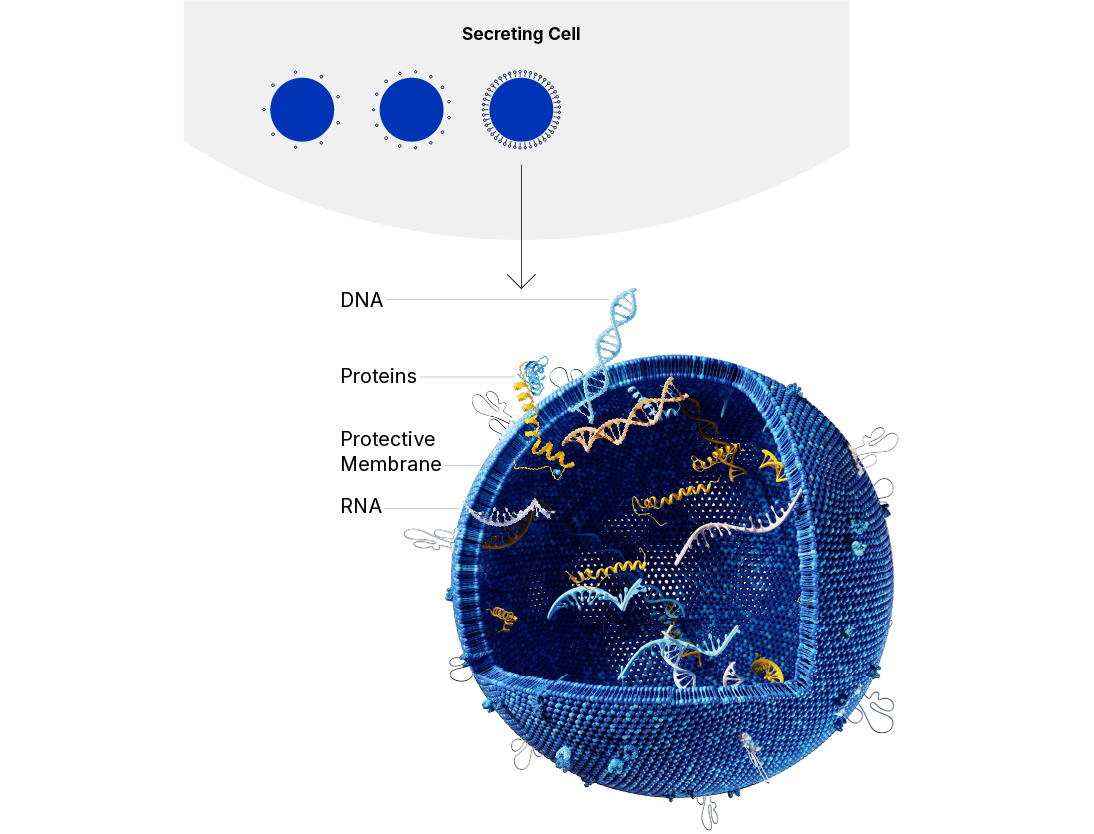
Extracellular Vesicles (EVs) are tiny, naturally produced vesicles released by all cell types that play a key role in cell-to-cell communication.
Advantages of EV-Enabled Biomarkers

Living CellsOne active cell can secrete tens of thousands of EVs per day while cfDNA is largely released from dying cells and in relatively low quantities. | Better Signal DetectionBecause EVs protect their biomarker contents from degradation, we are able to observe 60% more signal when the exoRNA is combined with the cfDNA than cfDNA alone1. | Earlier Disease DetectionEVs are abundant and are released as an active process in both early and late stages of disease. | Broad ApplicabilityEVs allow analysis of mutations, RNA profiles, and proteins. |
Explore the Basics
RNA, DNA, & Proteins
EVs are actively released by all cells, and contain multiple genomic and proteomic components: RNA, DNA, and proteins. Genomic tests that collect only freely circulating materials, suffer from a loss of signal due to the fragility of some biomarkers. The protective nature of extracellular vesicles allows EV-based assays to detect higher signal levels, finding important information that would otherwise be undetectable.
Communicators
Acting as one of the body’s natural messaging systems for intercellular communication, biomarker signals taken from within EVs allow us to clearly "listen" to what cells are saying to each other without the background noise, providing important information about what's happening in the body at a cellular level.
Disease Management
EVs can be harvested from multiple bodily fluids and utilized in all stages of disease management, from disease detection to stratification for therapeutics.
The Power of the Platform
Applications
Analytical Capablilty | EV Platforms | Cell-free DNA (cfDNA) |
|---|---|---|
| Combine EV-derived RNA and DNA (exoRNA/DNA) with cfDNA for increased mutation detection and sensitivity | X | |
| Detect fusion transcripts, splice variants, and other RNA biomarkers | X | |
| Detect stromal, inflammatory response, and other systematic disease changes | X | |
| Enable analysis of RNA, DNA, and protein profiles | X | |
| Enable enrichment for disease-specific signals within oncology as well as non-oncology | X |
Additional Applications | ||
|---|---|---|
| Simple workflow of sample acquisition, handling and processing | X | X |
| Enable extraction from fresh and biobanked samples | X | X |
| Detection and monitoring of cancer, immunological, metabolic, cardiovascular, and neurodegenerative diseases | X | |

The QuantideX qPCR ESR1 exoMutation Kit*
The QuantideX qPCR ESR1 exoMutation Kit is the first multianalyte liquid biopsy assay tailored for detecting ESR1 mutations. Designed to provide highly sensitive detection of the 11 most prevalent2 ESR1 variants in plasma. The kit utilizes both cell-free DNA (cfDNA) and exosomal RNA (exoRNA), a sub-category of EVs, which are isolated using the ExoLution Plus cfDNA + exoRNA Isolation Kit*, provided with the ESR1 exoMutation Kit.
1. Kelnar, K., et al. (2024, December). P4-07-25. San Antonio Breast Cancer Symposium (SABCS) 2024, San Antonio, TX.
2. Breast Cancer Res. 2021 Aug 15;23(1):85. 2. Lancet Oncol. 2022 Nov;23(11):1367-1377.
*For Research Use Only. Not for use in diagnostic procedures.