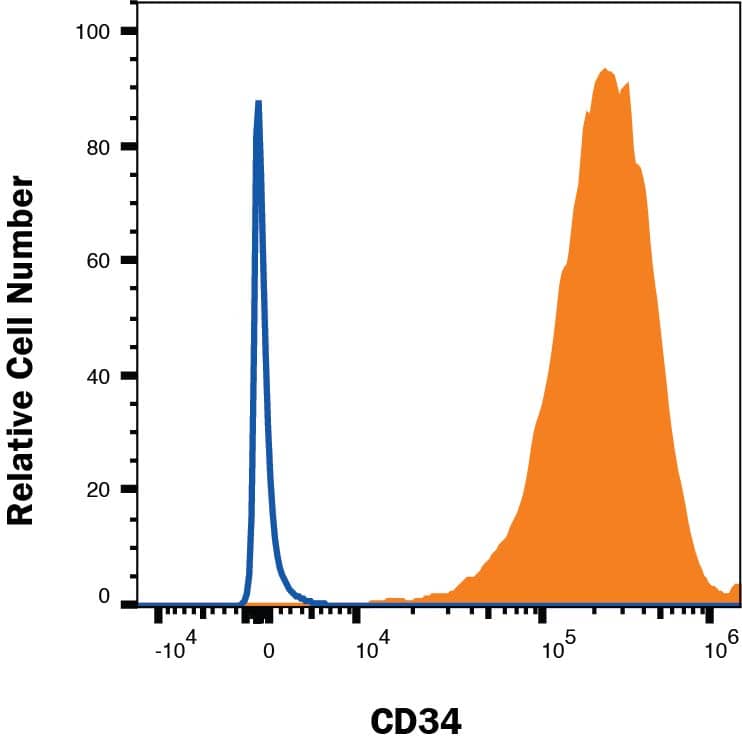
Detection of Human CD34 by Flow Cytometry
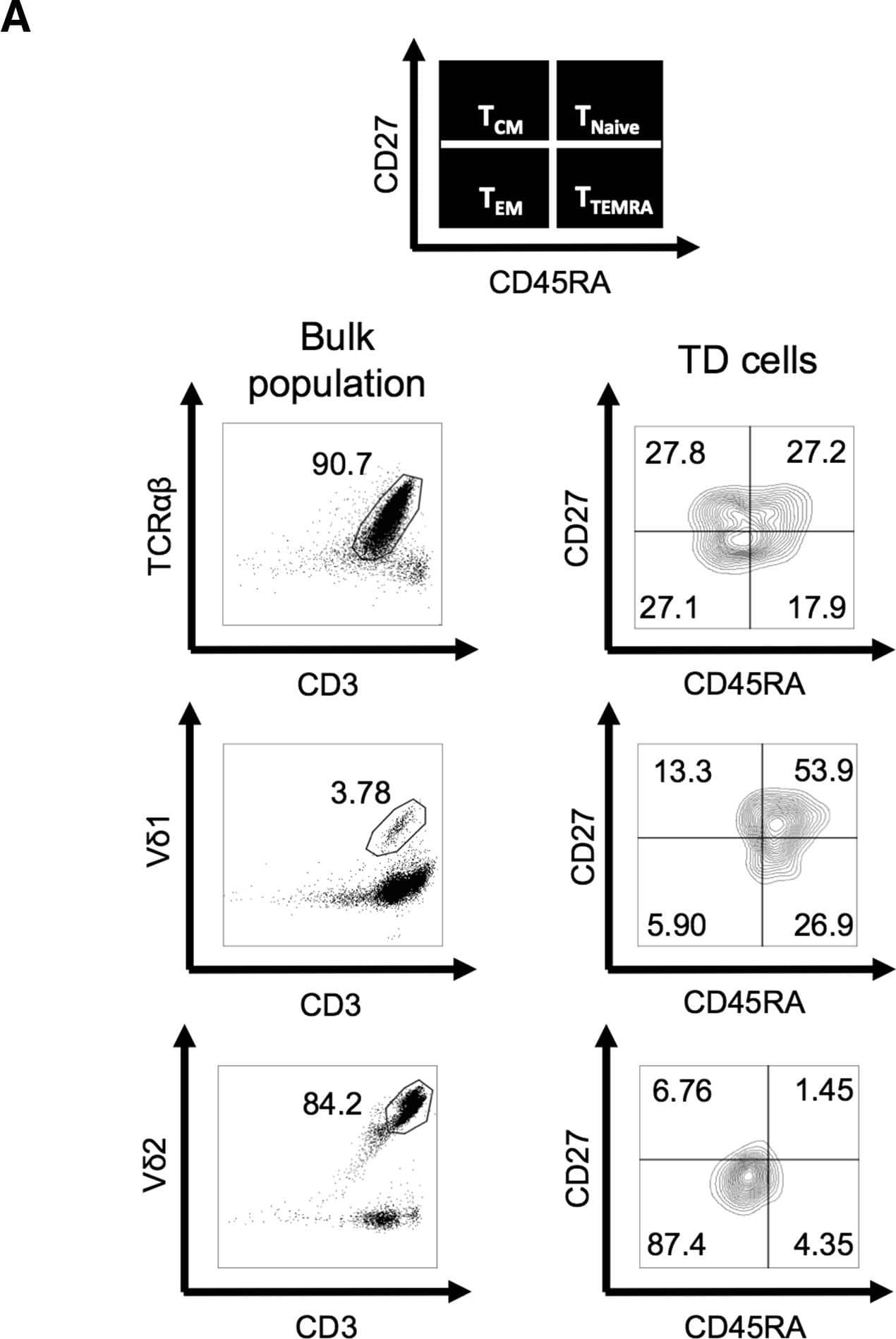
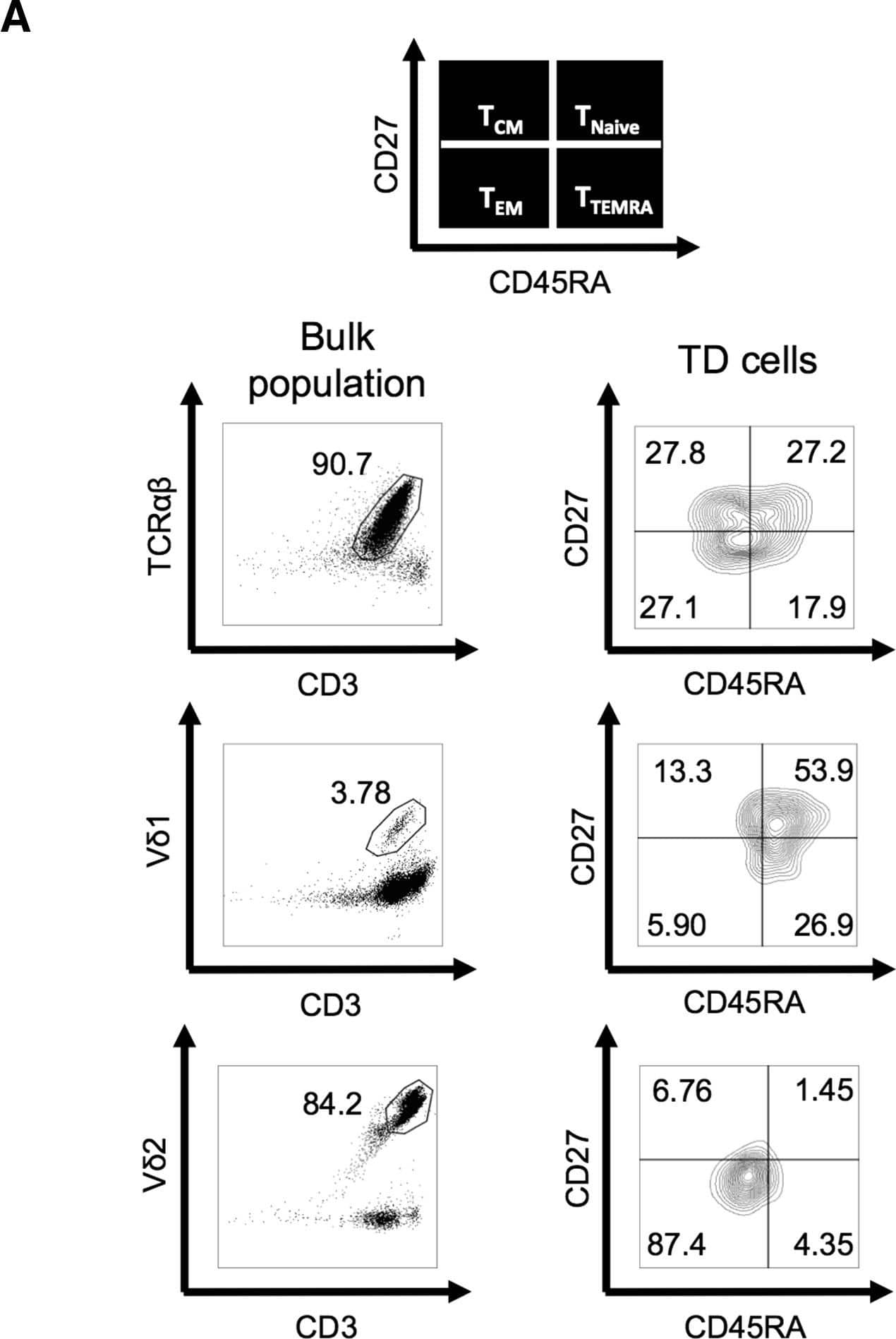
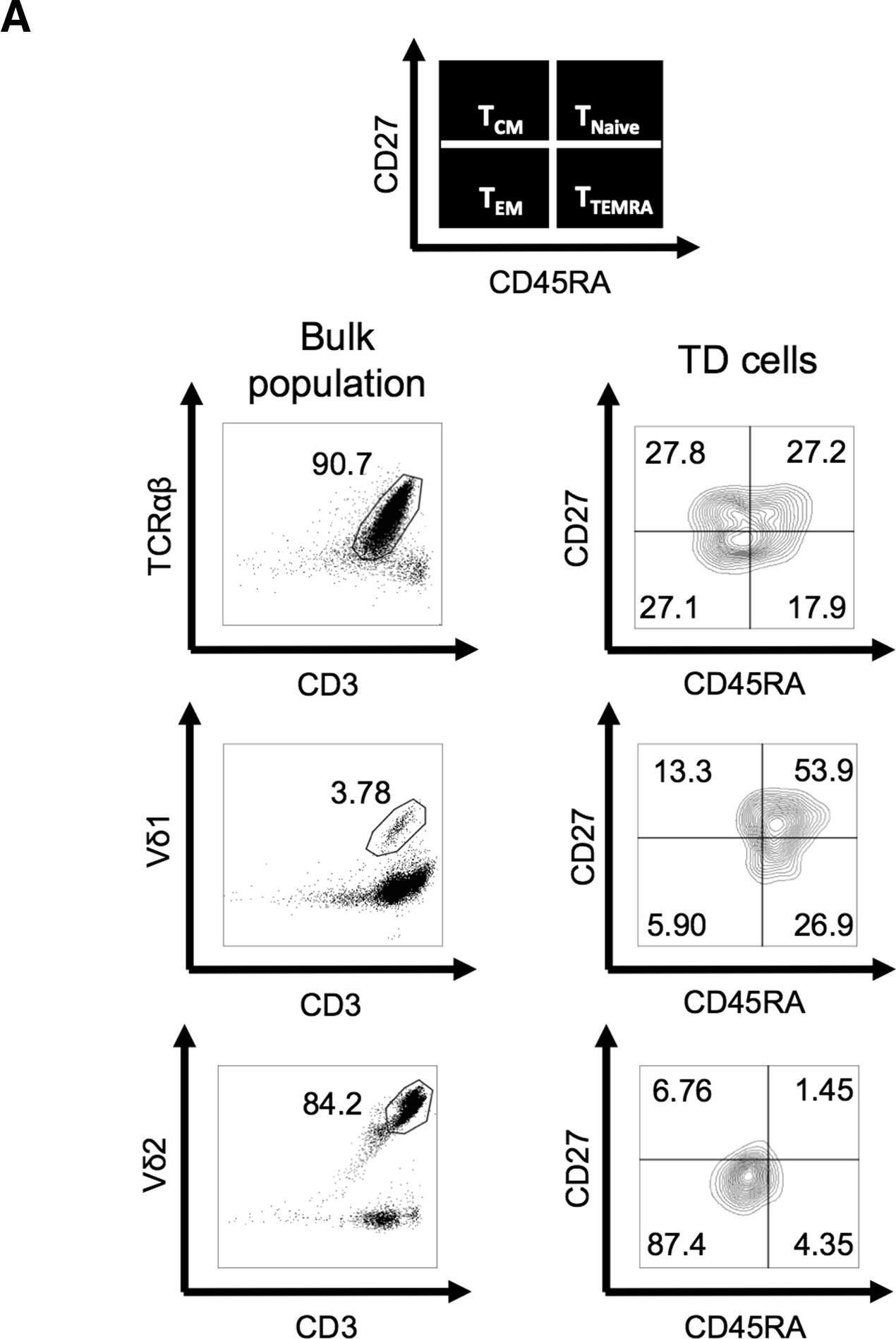
Memory Phenotype and Exhaustion Marker Expression on Expanded CD3+ alpha beta, V delta1+, and V delta2+ Live T Cells(A) Representative flow cytometry dot plot showing gating of T cell subtypes ( alpha beta, V delta1+, and V delta2+) and contour plots of the corresponding subtype memory phenotype (N, naive; CM, central memory; EM, effector memory; TEMRA, terminally differentiated effector memory) according to expression of CD27 and CD45RA. (B–D) memory phenotypes of pre-expanded PBMCs (B), post-expansion non-transduced (NTD) cells (C), and post-expansion GD2-CAR-transduced cells (D). alpha beta cells were stimulated with CD3/CD28 antibody, V delta1 cells were stimulated with ConA, and V delta2 cells were stimulated with ZOL (data represented as mean ± SEM; alpha beta and V delta2, n = 6; V delta1, n = 3). (E and F) Expanded V delta1+ cells transduced with CAR after ConA stimulation express significantly fewer exhaustion markers (PD1 and TIM3) than alpha beta and V delta2+ CAR-T cells. (E) Flow cytometry plots from a representative donor. alpha beta cells were stimulated with CD3/CD28 antibody, V delta1+ cells were stimulated with ConA, and V delta2+ cells were stimulated with ZOL. (F) PD1 and TIM3 expression on TD and NTD T cells 13 days following activation (data represented as mean ± SEM; alpha beta and V delta2+, n = 6; V delta1+, n = 3; p value for significance comparing double-negative populations). Image collected and cropped by CiteAb from the following publication (https://linkinghub.elsevier.com/retrieve/pii/S1525001617305981), licensed under a CC-BY license. Not internally tested by R&D Systems.
Detection of Human Human CD34 APC-conjugated Antibody by Flow Cytometry
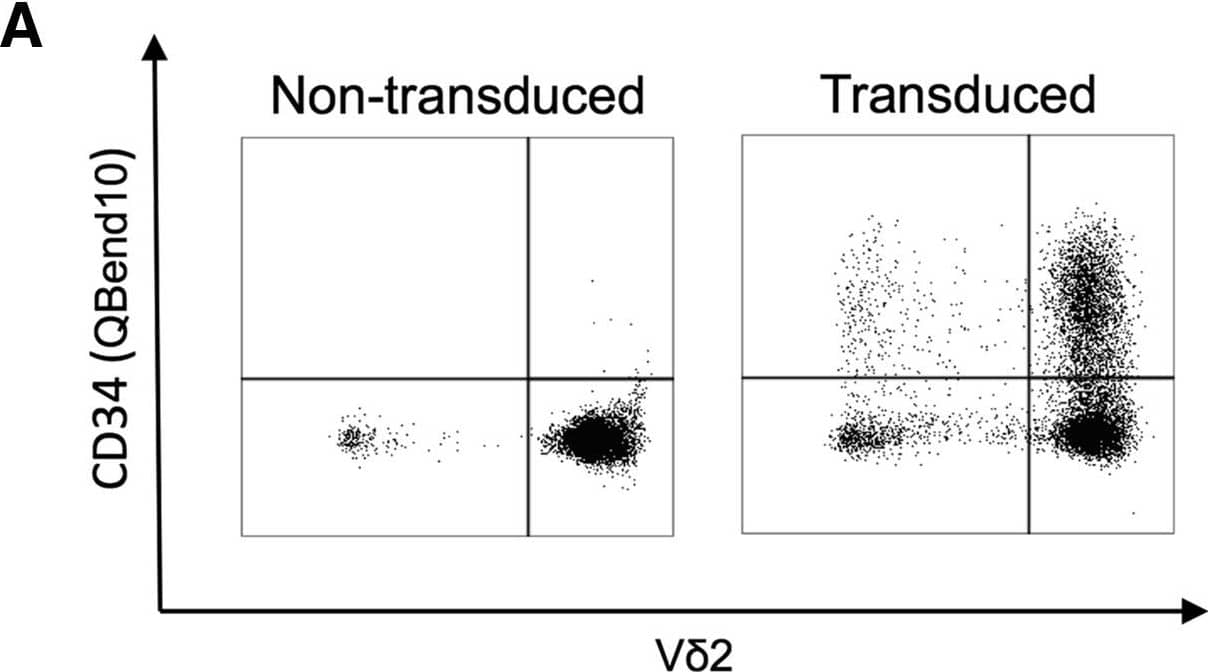
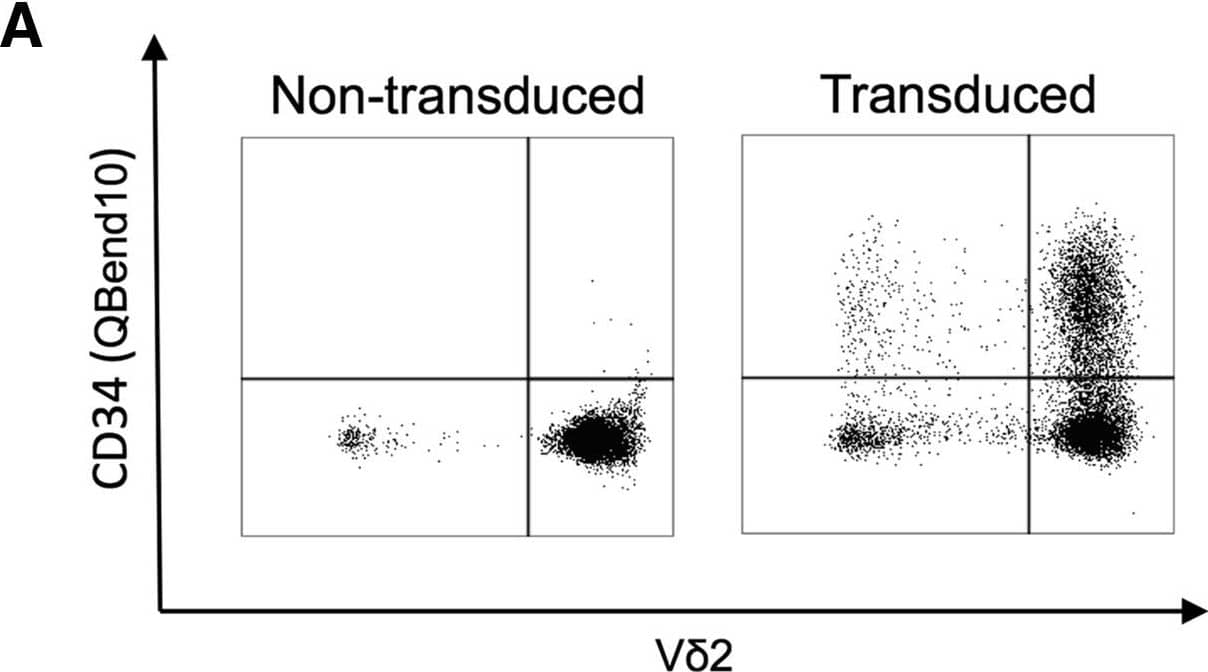
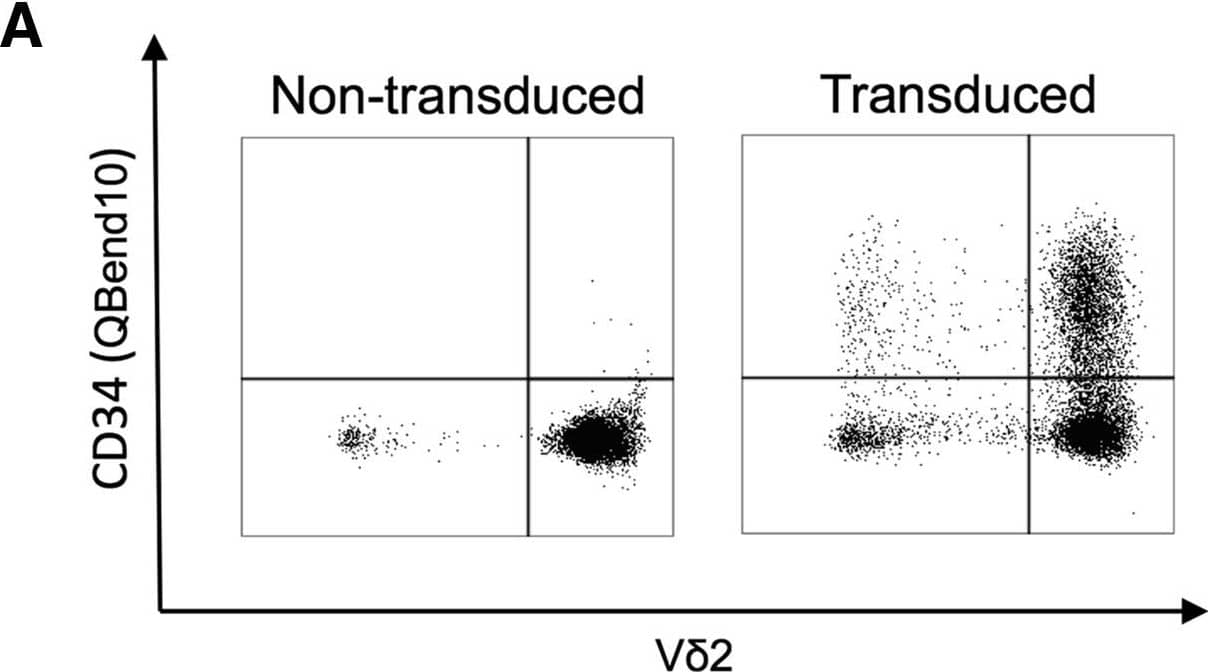
alpha beta, V delta1+, and V delta2+ T Cells Are Efficiently Transduced with GD2-CAR following Activation with CD3/CD28 Antibody, ZOL, or ConA, and Bulk Populations Are Cytotoxic to Neuroblastoma Cells(A) Representative flow cytometry dot plot showing transduction efficiency of ZOL-expanded non-transduced and GD2-CAR+-transduced PBMCs. V delta2+ populations were gated on CD3+ live cells 8 days following transduction. The GD2-CAR construct coexpresses the QBend10 epitope from CD34, allowing detection by flow cytometry. Transduction efficiency was determined by the percentage of QBend10+ in the T cell population gate compared to control non-transduced cells. (B–D) Mean transduction efficiency using CD3/CD28 antibody, ZOL, or ConA activation methods, respectively. Each data point represents an individual donor (n = 9) and each horizontal line is the mean. (E–G) Bulk populations of GD2-CAR-transduced T cells stimulated by CD3/CD28 antibody (E), ZOL (F), and ConA (G) specifically lyse the GD2-expressing neuroblastoma cell line, LAN1, in 4-hr 51Cr release assay. NTD, non-transduced T cells; TD, transduced GD2-CAR+ T cells (data represented as mean ± SEM; 3–5 individual donors in triplicate). Image collected and cropped by CiteAb from the following publication (https://pubmed.ncbi.nlm.nih.gov/29310916), licensed under a CC-BY license. Not internally tested by R&D Systems.
Detection of Human Human CD34 APC-conjugated Antibody by Flow Cytometry
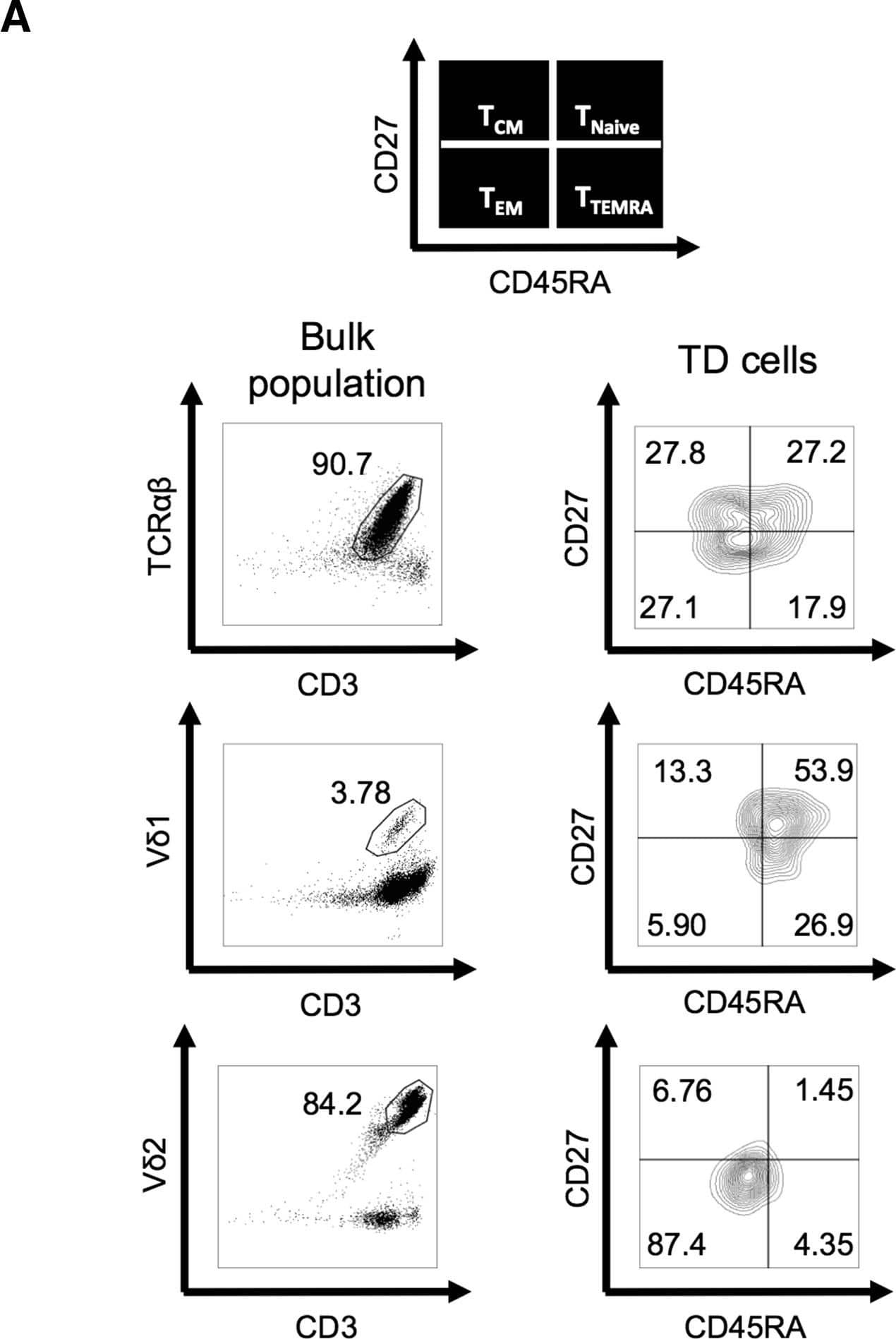
Memory Phenotype and Exhaustion Marker Expression on Expanded CD3+ alpha beta, V delta1+, and V delta2+ Live T Cells(A) Representative flow cytometry dot plot showing gating of T cell subtypes ( alpha beta, V delta1+, and V delta2+) and contour plots of the corresponding subtype memory phenotype (N, naive; CM, central memory; EM, effector memory; TEMRA, terminally differentiated effector memory) according to expression of CD27 and CD45RA. (B–D) memory phenotypes of pre-expanded PBMCs (B), post-expansion non-transduced (NTD) cells (C), and post-expansion GD2-CAR-transduced cells (D). alpha beta cells were stimulated with CD3/CD28 antibody, V delta1 cells were stimulated with ConA, and V delta2 cells were stimulated with ZOL (data represented as mean ± SEM; alpha beta and V delta2, n = 6; V delta1, n = 3). (E and F) Expanded V delta1+ cells transduced with CAR after ConA stimulation express significantly fewer exhaustion markers (PD1 and TIM3) than alpha beta and V delta2+ CAR-T cells. (E) Flow cytometry plots from a representative donor. alpha beta cells were stimulated with CD3/CD28 antibody, V delta1+ cells were stimulated with ConA, and V delta2+ cells were stimulated with ZOL. (F) PD1 and TIM3 expression on TD and NTD T cells 13 days following activation (data represented as mean ± SEM; alpha beta and V delta2+, n = 6; V delta1+, n = 3; p value for significance comparing double-negative populations). Image collected and cropped by CiteAb from the following publication (https://pubmed.ncbi.nlm.nih.gov/29310916), licensed under a CC-BY license. Not internally tested by R&D Systems.
Detection of Human CD34 by Flow Cytometry
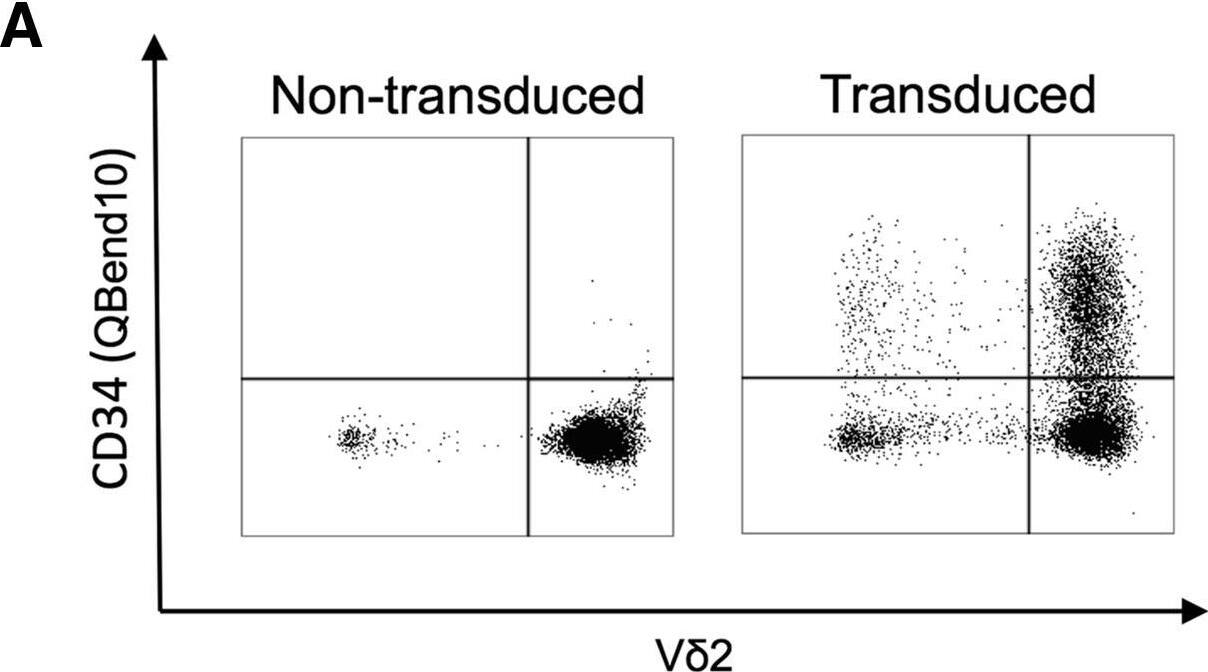
alpha beta, V delta1+, and V delta2+ T Cells Are Efficiently Transduced with GD2-CAR following Activation with CD3/CD28 Antibody, ZOL, or ConA, and Bulk Populations Are Cytotoxic to Neuroblastoma Cells(A) Representative flow cytometry dot plot showing transduction efficiency of ZOL-expanded non-transduced and GD2-CAR+-transduced PBMCs. V delta2+ populations were gated on CD3+ live cells 8 days following transduction. The GD2-CAR construct coexpresses the QBend10 epitope from CD34, allowing detection by flow cytometry. Transduction efficiency was determined by the percentage of QBend10+ in the T cell population gate compared to control non-transduced cells. (B–D) Mean transduction efficiency using CD3/CD28 antibody, ZOL, or ConA activation methods, respectively. Each data point represents an individual donor (n = 9) and each horizontal line is the mean. (E–G) Bulk populations of GD2-CAR-transduced T cells stimulated by CD3/CD28 antibody (E), ZOL (F), and ConA (G) specifically lyse the GD2-expressing neuroblastoma cell line, LAN1, in 4-hr 51Cr release assay. NTD, non-transduced T cells; TD, transduced GD2-CAR+ T cells (data represented as mean ± SEM; 3–5 individual donors in triplicate). Image collected and cropped by CiteAb from the following open publication (https://pubmed.ncbi.nlm.nih.gov/29310916), licensed under a CC-BY license. Not internally tested by R&D Systems.
Detection of Human CD34 by Flow Cytometry
Memory Phenotype and Exhaustion Marker Expression on Expanded CD3+ alpha beta, V delta1+, and V delta2+ Live T Cells(A) Representative flow cytometry dot plot showing gating of T cell subtypes ( alpha beta, V delta1+, and V delta2+) and contour plots of the corresponding subtype memory phenotype (N, naive; CM, central memory; EM, effector memory; TEMRA, terminally differentiated effector memory) according to expression of CD27 and CD45RA. (B–D) memory phenotypes of pre-expanded PBMCs (B), post-expansion non-transduced (NTD) cells (C), and post-expansion GD2-CAR-transduced cells (D). alpha beta cells were stimulated with CD3/CD28 antibody, V delta1 cells were stimulated with ConA, and V delta2 cells were stimulated with ZOL (data represented as mean ± SEM; alpha beta and V delta2, n = 6; V delta1, n = 3). (E and F) Expanded V delta1+ cells transduced with CAR after ConA stimulation express significantly fewer exhaustion markers (PD1 and TIM3) than alpha beta and V delta2+ CAR-T cells. (E) Flow cytometry plots from a representative donor. alpha beta cells were stimulated with CD3/CD28 antibody, V delta1+ cells were stimulated with ConA, and V delta2+ cells were stimulated with ZOL. (F) PD1 and TIM3 expression on TD and NTD T cells 13 days following activation (data represented as mean ± SEM; alpha beta and V delta2+, n = 6; V delta1+, n = 3; p value for significance comparing double-negative populations). Image collected and cropped by CiteAb from the following open publication (https://pubmed.ncbi.nlm.nih.gov/29310916), licensed under a CC-BY license. Not internally tested by R&D Systems.
Detection of Human CD34 by Flow Cytometry
alpha beta, V delta1+, and V delta2+ T Cells Are Efficiently Transduced with GD2-CAR following Activation with CD3/CD28 Antibody, ZOL, or ConA, and Bulk Populations Are Cytotoxic to Neuroblastoma Cells(A) Representative flow cytometry dot plot showing transduction efficiency of ZOL-expanded non-transduced and GD2-CAR+-transduced PBMCs. V delta2+ populations were gated on CD3+ live cells 8 days following transduction. The GD2-CAR construct coexpresses the QBend10 epitope from CD34, allowing detection by flow cytometry. Transduction efficiency was determined by the percentage of QBend10+ in the T cell population gate compared to control non-transduced cells. (B–D) Mean transduction efficiency using CD3/CD28 antibody, ZOL, or ConA activation methods, respectively. Each data point represents an individual donor (n = 9) and each horizontal line is the mean. (E–G) Bulk populations of GD2-CAR-transduced T cells stimulated by CD3/CD28 antibody (E), ZOL (F), and ConA (G) specifically lyse the GD2-expressing neuroblastoma cell line, LAN1, in 4-hr 51Cr release assay. NTD, non-transduced T cells; TD, transduced GD2-CAR+ T cells (data represented as mean ± SEM; 3–5 individual donors in triplicate). Image collected and cropped by CiteAb from the following open publication (https://pubmed.ncbi.nlm.nih.gov/29310916), licensed under a CC-BY license. Not internally tested by R&D Systems.
Detection of Human CD34 by Flow Cytometry
Memory Phenotype and Exhaustion Marker Expression on Expanded CD3+ alpha beta, V delta1+, and V delta2+ Live T Cells(A) Representative flow cytometry dot plot showing gating of T cell subtypes ( alpha beta, V delta1+, and V delta2+) and contour plots of the corresponding subtype memory phenotype (N, naive; CM, central memory; EM, effector memory; TEMRA, terminally differentiated effector memory) according to expression of CD27 and CD45RA. (B–D) memory phenotypes of pre-expanded PBMCs (B), post-expansion non-transduced (NTD) cells (C), and post-expansion GD2-CAR-transduced cells (D). alpha beta cells were stimulated with CD3/CD28 antibody, V delta1 cells were stimulated with ConA, and V delta2 cells were stimulated with ZOL (data represented as mean ± SEM; alpha beta and V delta2, n = 6; V delta1, n = 3). (E and F) Expanded V delta1+ cells transduced with CAR after ConA stimulation express significantly fewer exhaustion markers (PD1 and TIM3) than alpha beta and V delta2+ CAR-T cells. (E) Flow cytometry plots from a representative donor. alpha beta cells were stimulated with CD3/CD28 antibody, V delta1+ cells were stimulated with ConA, and V delta2+ cells were stimulated with ZOL. (F) PD1 and TIM3 expression on TD and NTD T cells 13 days following activation (data represented as mean ± SEM; alpha beta and V delta2+, n = 6; V delta1+, n = 3; p value for significance comparing double-negative populations). Image collected and cropped by CiteAb from the following open publication (https://pubmed.ncbi.nlm.nih.gov/29310916), licensed under a CC-BY license. Not internally tested by R&D Systems.